Blog · AI Trends
This Was The Week In AI #37
Olaf Lemmens, Founder NinA AI Agency · June 29, 2026 · 8 min read

Two weeks ago the US government shut off access to two of the most powerful AI models in the world. No lawsuit, no lengthy announcement. Just: closed.
A lot has happened since. Anthropic negotiated with Washington daily to get their own products back.
Last week OpenAI quietly rolled out a new voice that finally feels like a conversation. A Japanese lab made a serious claim about their AI model, and Claude showed up as a colleague in your Slack.
Four developments. One clear common thread: AI is growing up, and grown-up technology attracts politics, regulation and strategic interests.
In this newsletter we line it all up: what happened with Mythos 5, how Claude Tag works, what Bidi 1 changes about voice, and why Fugu is interesting but not something to trust blindly yet.
This was the week in AI #37.
TLDR;
Mythos 5 is allowed back, but only for critical infrastructure
Claude is now a colleague in your Slack channel
OpenAI’s new voice finally listens
Claude as a colleague in Slack
Claude Tag is live and it works exactly as it sounds: you tag @Claude in a Slack channel, set a task, and Claude breaks that task into steps, works through them, and posts the results back in the thread. No new tab. No separate dashboard. Just your existing workplace.
Tag Claude in a channel. Give an instruction. Claude reads the channel context, breaks the task into steps and completes those steps with the tools it has access to. The result appears in the thread.
What makes it interesting: Claude builds context over time. One Claude lives in every channel, so a colleague can build on a task already started without you having to explain everything again. And with ambient mode Claude pulls in information from relevant channels itself and follows up on stalled threads automatically.
Karpathy describes Claude Tag as the “third major redesign of the AI interface.” First there was the chat box. Then the desktop agent. Now the colleague in your existing work environment.
Hard to disagree with that.
Anthropic now writes 65% of its own product code with Claude. So Claude Tag is not just a product Anthropic sells. It is also a product Anthropic actively uses itself.
The beta is now available to Enterprise and Team customers on Slack.
That does not mean this is instantly the holy grail for everyone. But it does shift something fundamental: AI is no longer in a separate window you open when you think of it. It sits in the flow of the work itself, where the context is already present and the collaboration is already happening.
That makes this different from most AI tools of the past year. And for teams that already live in Slack, worth exploring seriously.
Mythos 5 is back. Partly.
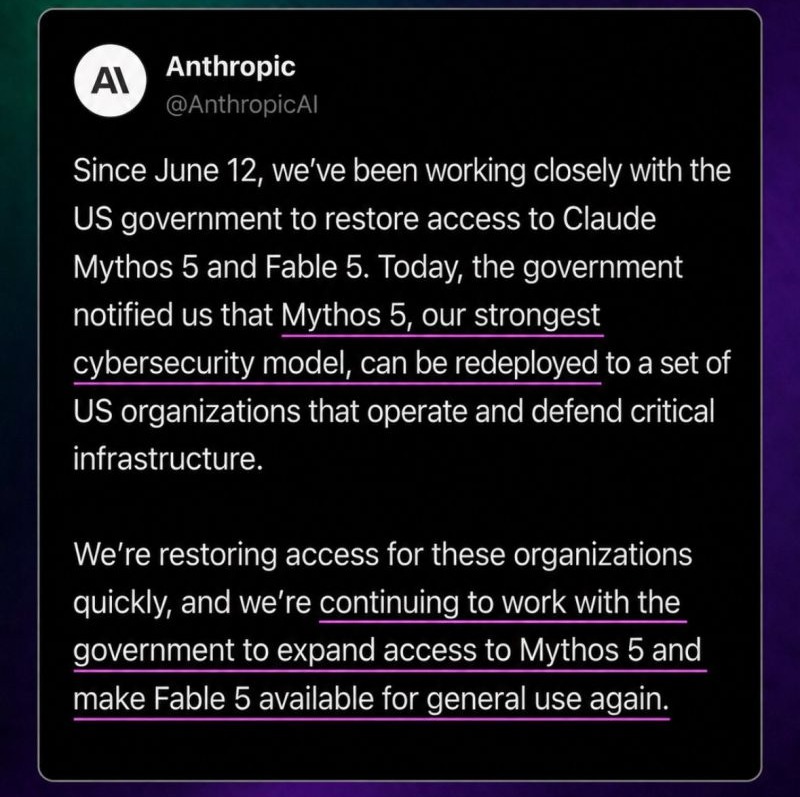
On 12 June the US government shut off access to two of Anthropic’s most powerful models: Mythos 5 and Fable 5. No advance announcement. Just: closed. (Read the newsletter about that too!)
Two weeks of daily conversations with Washington later, there is movement.
The government has given the green light for redeploying Mythos 5, but not for everyone. Only for a select group of organisations that manage and defend critical infrastructure. Think: energy companies, hospital networks, federal agencies. Companies whose system outages are immediately felt in the daily lives of ordinary people.
Fable 5, the version for the wider public, stays offline for now. Anthropic is still negotiating its return.
Mythos 5 is Anthropic’s strongest cybersecurity model. It can independently find software vulnerabilities in complex systems, faster than human teams can. That exact capability made it interesting to the government and, at the same time, sensitive enough to freeze temporarily.
Now that the model is back with the approved parties, it scans the networks behind power grids and hospitals. Protection you do not see, but do notice when it disappears.
Look, the point is simple: AI models are increasingly treated as strategic assets. Not only by companies, but by governments. The question of who gets access, on what terms and with what oversight, is becoming a political question. Not a technical one.
That Anthropic spent two weeks negotiating intensively with Washington to be allowed to deploy their own product again is a sign of the times. This is the world we are heading into.
A Japanese lab joins the AI fight
While Anthropic negotiates to get Mythos 5 and Fable 5 back, Japan’s Sakana AI has already taken a different route.
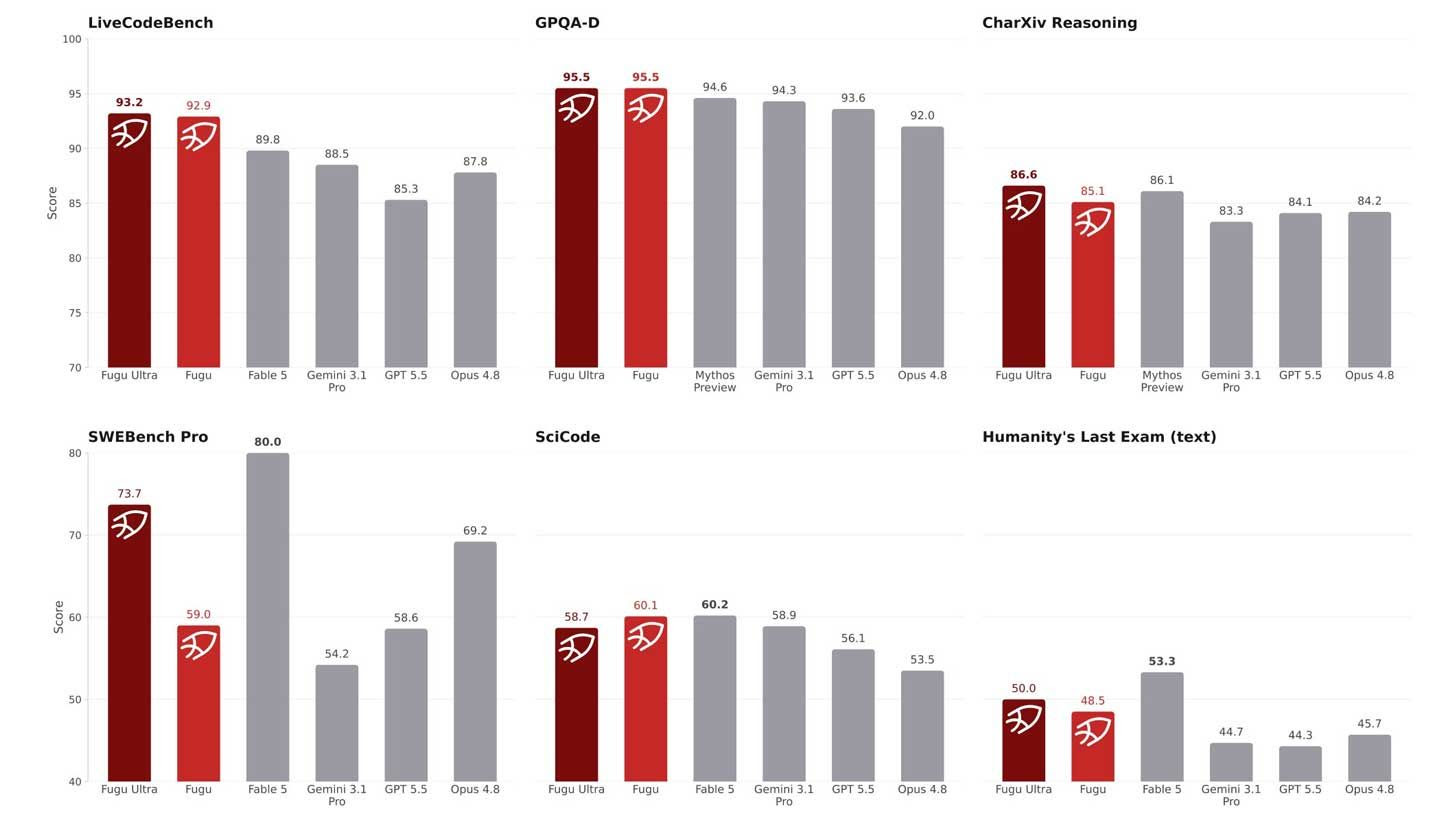
Their new model is called Fugu. And technically it is not a model. It is an orchestrator.
Fugu picks per task which underlying model does the work, splits up the steps, checks the results and merges everything into one answer. To the user it looks like a single API call. What happens behind the scenes is completely hidden.
It comes in two variants. The standard Fugu is built for speed: daily use, code, chat. Fugu Ultra pulls in heavier models for more complex jobs such as patent research and security analysis. Think of Gemini, GPT and Opus as the helpers underneath.
Sakana says both variants perform at or near the level of Fable 5 and the Mythos Preview. On multiple coding, reasoning and science benchmarks.
But: early user experiences are mixed. Several people report that real-world performance does not match the benchmarks. Costs are unclear. And exactly which models run under the hood is not transparent.
The idea, where you are not dependent on one provider, is interesting. Certainly given the developments of recent weeks. But for now this falls into the category: promising concept, proof not yet delivered.
Read our newsletter about Sakana Fugu here!
ChatGPT finally gets a voice that listens
Anyone who has had a longer session with ChatGPT’s current voice mode knows the problem: the thing forgets what you said ten minutes ago, jumps in while you are thinking, and feels more like a nervous intern than a conversation partner.
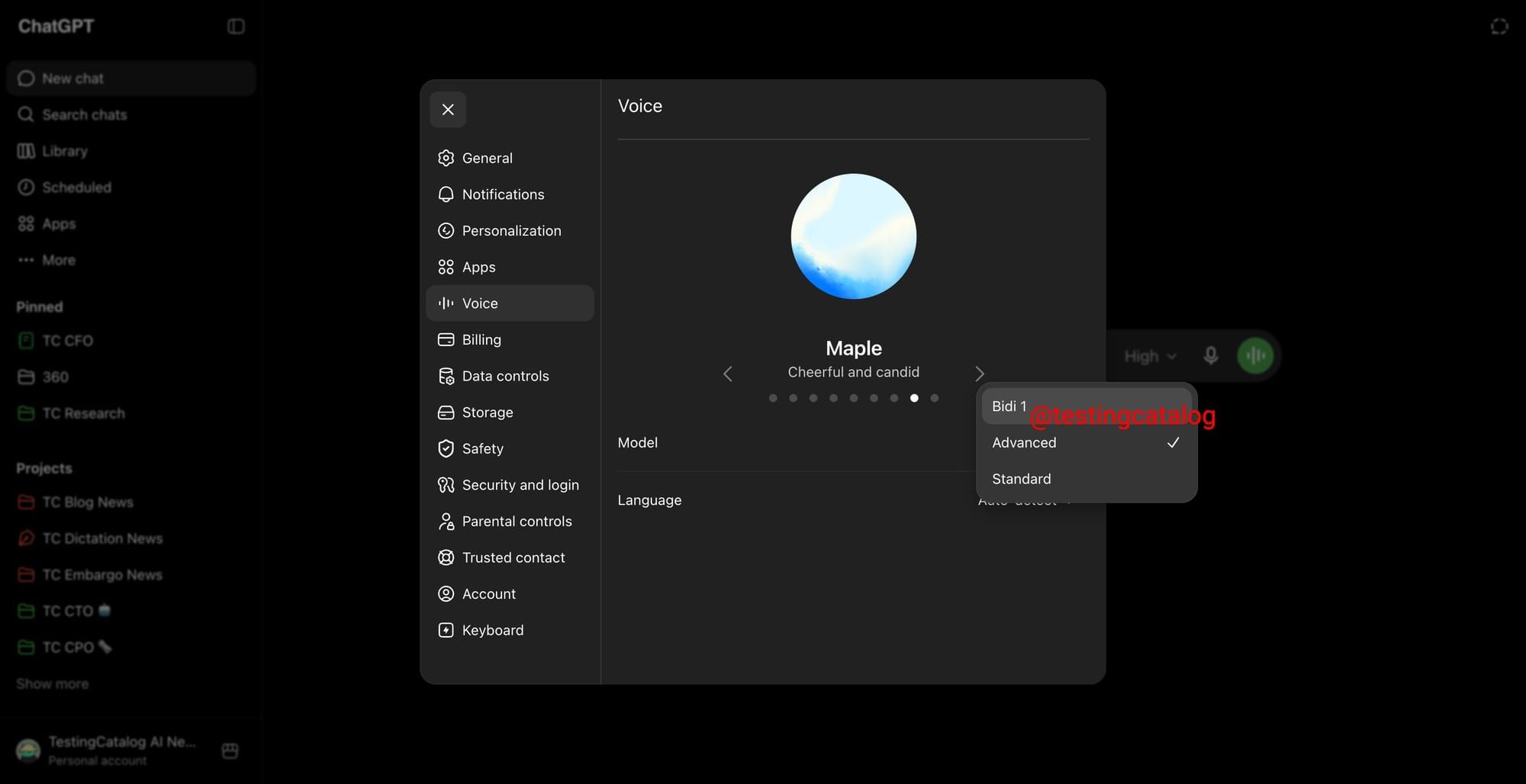
OpenAI will soon roll out Bidi 1. Short for bidirectional: the model speaks, hears and listens at the same time.
In early tests the difference is immediately noticeable. Bidi 1 gives small natural acknowledgements (“okay”, a short nod) when you pause, without interrupting you. It adapts mid-conversation when you change direction. And it holds the thread of an entire conversation instead of dropping earlier context.
That last point was the weakest spot of the current voice stack for years. It now looks like OpenAI has taken that problem seriously.
Bidi 1 appears in the model selector under settings, alongside the standard and advanced options. The voice bubble turns yellow once you select it. The rollout starts opt-in via web and mobile. Whether the European Economic Area is included right away has not been confirmed.
OpenAI has not officially announced this yet. The references surfaced in the ChatGPT interface itself and some users have already been given access. A formal announcement will probably follow soon.
Codex gets its own voice upgrade later. API access is also planned, but without a confirmed timeline.
My take
Honestly: this was an unusual week to follow.
Not because there was one big breakthrough, but because four seemingly separate developments together show something I hear more and more in conversations with entrepreneurs and developers.
On Mythos 5: the fact that Anthropic had to negotiate daily for two weeks to be allowed to redeploy their own model is a turning point. AI models are now treated as strategic export goods, just like semiconductors or weapons systems. That is new. And it means that any organisation leaning seriously on one provider is running a risk that did not exist a year ago.
On Claude Tag: conceptually I find this the most interesting release of the week. Not because it has impressive benchmarks, but because it changes the question. For years the question was: “how do I use AI in my work?” Now it becomes: “how do I direct the AI that is already doing my work?” That is a different mindset. And honestly, most teams are not ready for it yet. We have added this ourselves and will be playing with it in the coming period!
On Bidi 1: voice mode was always the part of ChatGPT I recommended least. Too fast, too forgetful, too forced. If the early tests hold up, that changes. Holding context across an entire conversation is exactly what voice mode needed to become useful for anything beyond a quick search query. I am cautiously optimistic, but waiting for the broader rollout.
On Fugu: the idea is smart. The execution is not convincing yet. Benchmarks that do not match real-world experience, unclear costs and no transparency about which models are running. Those are not small objections. But the concept, where you are not dependent on one provider and automatically reroute if a provider drops out, is only going to get more relevant in the coming months. This is worth continuing to follow.
The overarching conclusion? AI has become infrastructure. And infrastructure attracts governments, demands redundancy and requires you to think about dependency.
That may well be the most important insight of this week.
Until next time,
Olaf Lemmens
Founder NinA AI Agency
P.S. Want to talk through how AI could work in your organisation? Or how tools like these could save you time in your work? Book an intro call through this link.