Blog · AI & Business
The Great AI Race: Who Wins the Consumer?
Olaf Lemmens & Daan van Drunen, Founder & AI Consultant NinA AI Agency · March 10, 2026 · 10 min read

The sixth edition of a16z's Top 100 Gen AI list shows the playing field is shifting and the battle for your default AI has just begun.
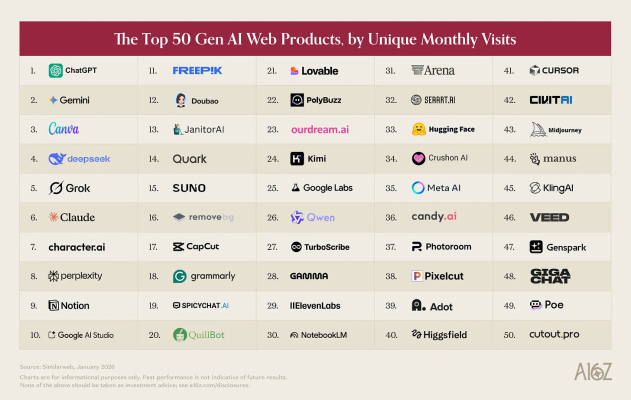
Three years ago, a16z published its first list of the most-used generative AI tools. Back then it was simple: ChatGPT, Midjourney and Character.AI were clearly AI-first. The rest of the software world was still watching.
That distinction no longer exists.
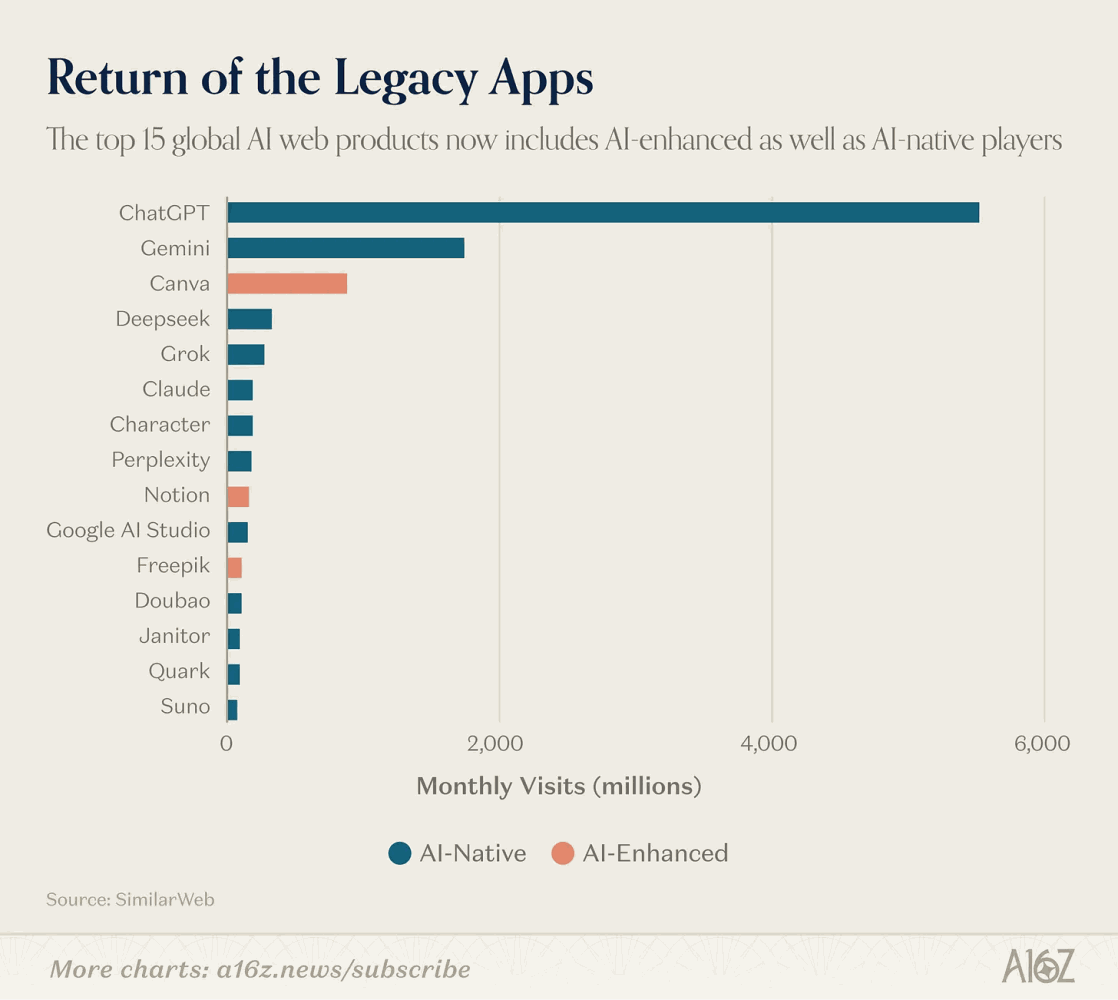
CapCut has 736 million monthly mobile users thanks to AI features like background removal and automatic subtitling. Canva built its growth engine entirely around AI tools. And at Notion, the share of paying customers using AI features rose from 20% to over 50% in one year.
From this edition onward, a16z counts not only AI-native products, but every consumer product where generative AI has become a core part of the experience. The result is a more honest picture of how people actually use AI.
These are the key insights.
TL;DR
- ▸ChatGPT leads, but competitors are growing faster
- ▸AI agents are shifting from hype to real adoption
- ▸Creative AI tools are bundling into major platforms
ChatGPT dominates, but the gap is shrinking
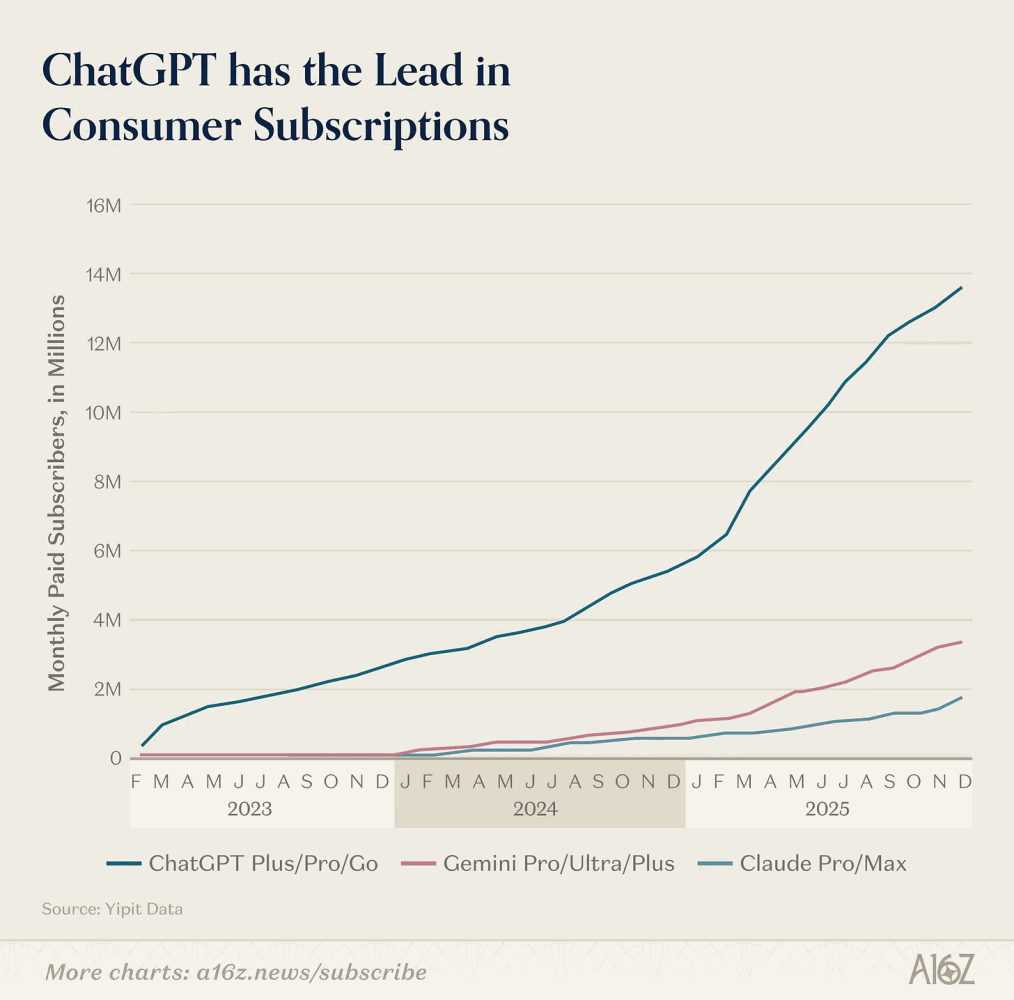
ChatGPT is still by far the largest AI consumer product in the world. On the web it's 2.7x larger than number two Gemini. On mobile 2.5x. Weekly active users grew by 500 million to 900 million over the past year — more than 10% of the world's population.
But the competition is coming.
Claude is growing paid subscribers by over 200% year-over-year. Gemini by 258%. And about 20% of weekly ChatGPT web users also open Gemini in the same week. Multi-tenanting is the new norm.
What changed? The competitors delivered. Google scored with Nano Banana (200 million generated images in one week) and Veo 3, widely seen as the breakthrough moment for AI video. Anthropic doubled down on the power user with Claude Code, Cowork and integrations in Chrome, Excel and PowerPoint.
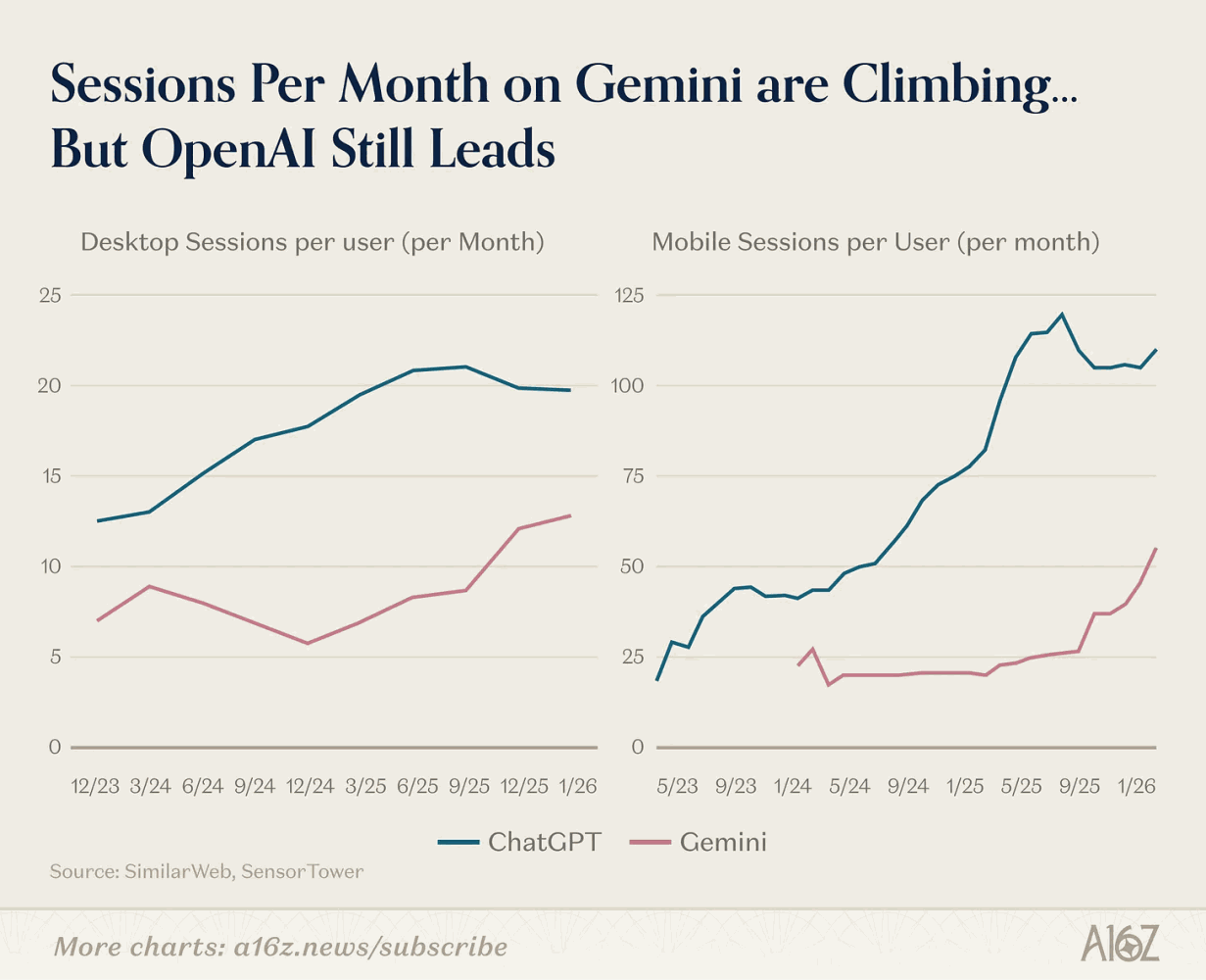
ChatGPT still has the highest session frequency per user — 1.3x higher on desktop, 2.2x higher on mobile. But Gemini is steadily rising.
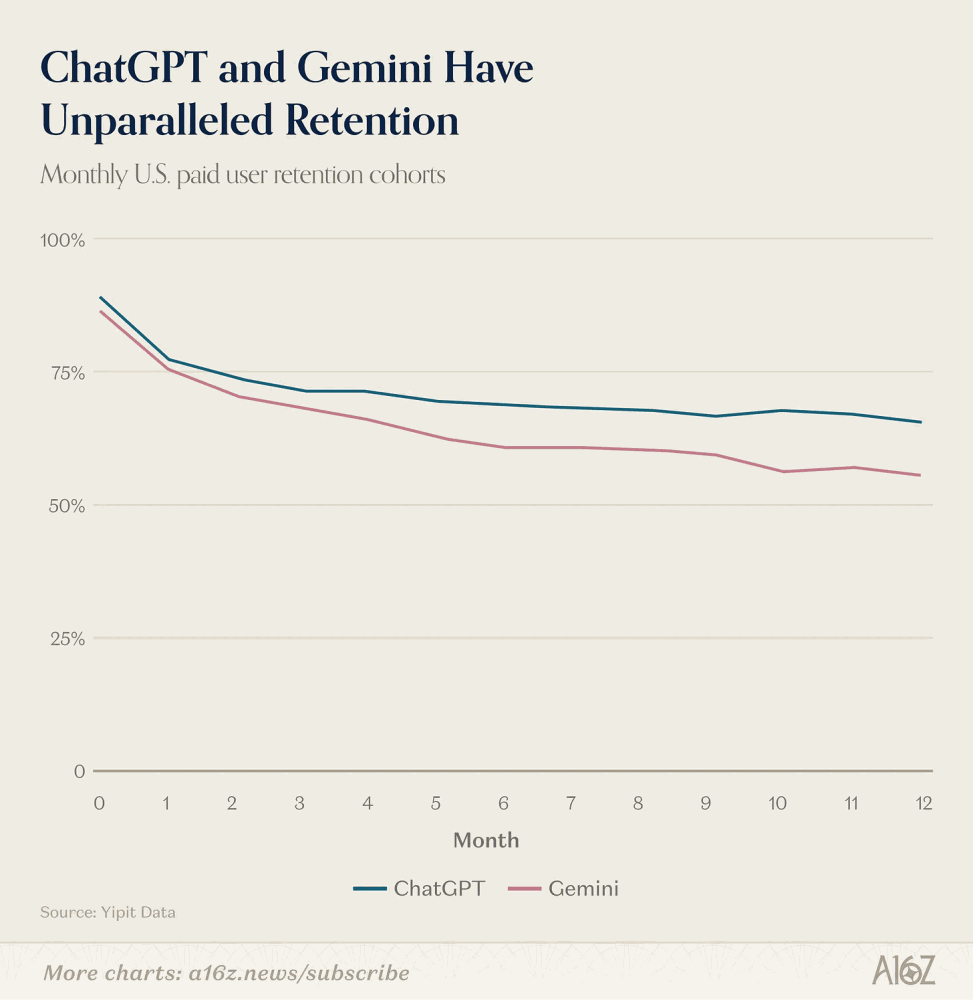
Paid user retention is impressive on both platforms. After twelve months, about 65% of American ChatGPT subscribers still pay. For Gemini it's around 57%.
The app store as battlefield
The next layer of lock-in is the app environment. ChatGPT and Claude have both launched ecosystems where users build workflows on top of the assistant — think calendar, email and CRM integrations. Once you've set that up, switching costs rise dramatically.
The directions are already diverging.
ChatGPT has more than 220 apps in 13 categories. Claude has about 160 curated connectors plus some 50 community MCP servers. Only 41 apps appear in both. Almost exclusively the universal productivity tools like Slack, Notion, Figma and Gmail.
Beyond that? Total divergence.
ChatGPT has 85+ apps in Travel, Shopping, Food, Health and Entertainment. Think Expedia, Instacart, Zillow, MyFitnessPal. It's the most aggressive attempt by an AI company to become a super-app.
Claude focuses on the professional: financial data terminals (PitchBook, FactSet), developer infrastructure (Sentry, Supabase, Snowflake) and medical tools (PubMed, Benchling).
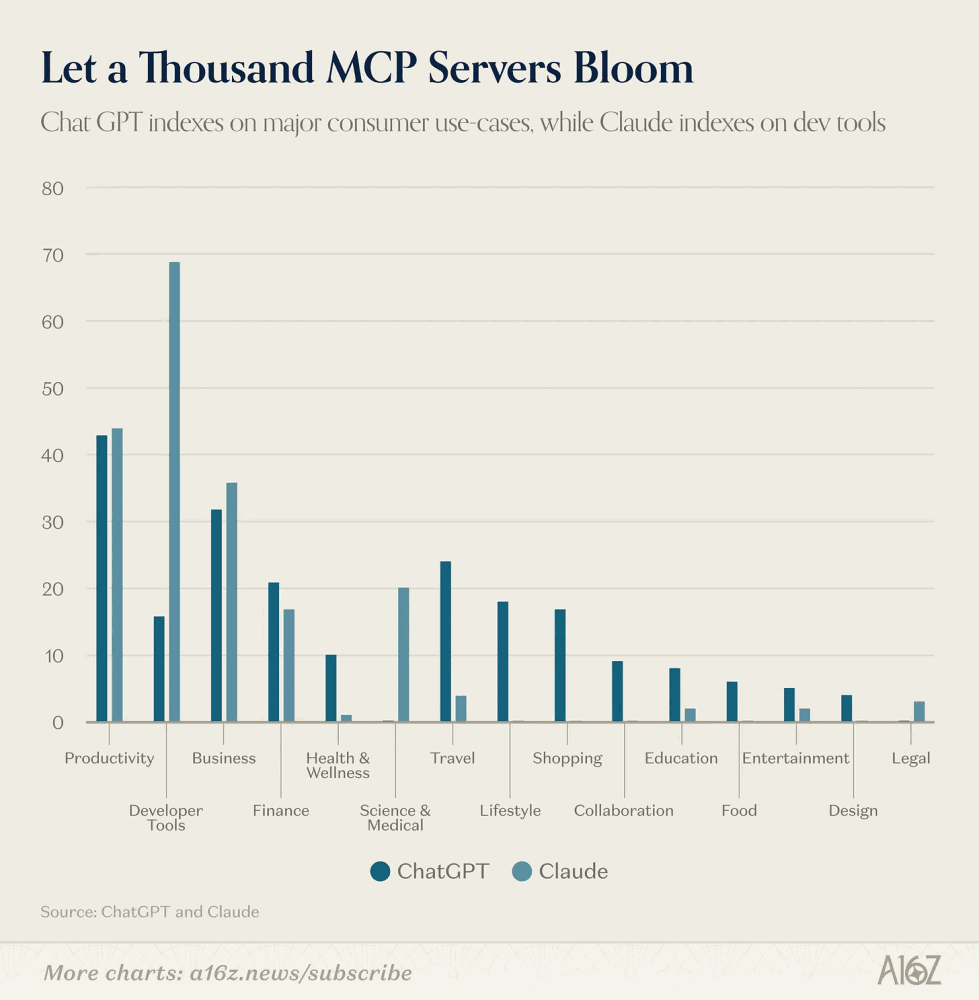
Sam Altman wants to position ChatGPT as the starting point for everything — including a "Sign in with ChatGPT" identity layer. Anthropic seems to be betting on the AI power user willing to pay directly.
If the AI assistant becomes not just a chat window but an operating system, this race looks less like the search war (one winner with 90%) and more like the battle between iOS and Android — two platforms with totally different philosophies that both built trillion-dollar ecosystems.
The world splits into three AI ecosystems
Geographically, the AI market falls into three blocks.
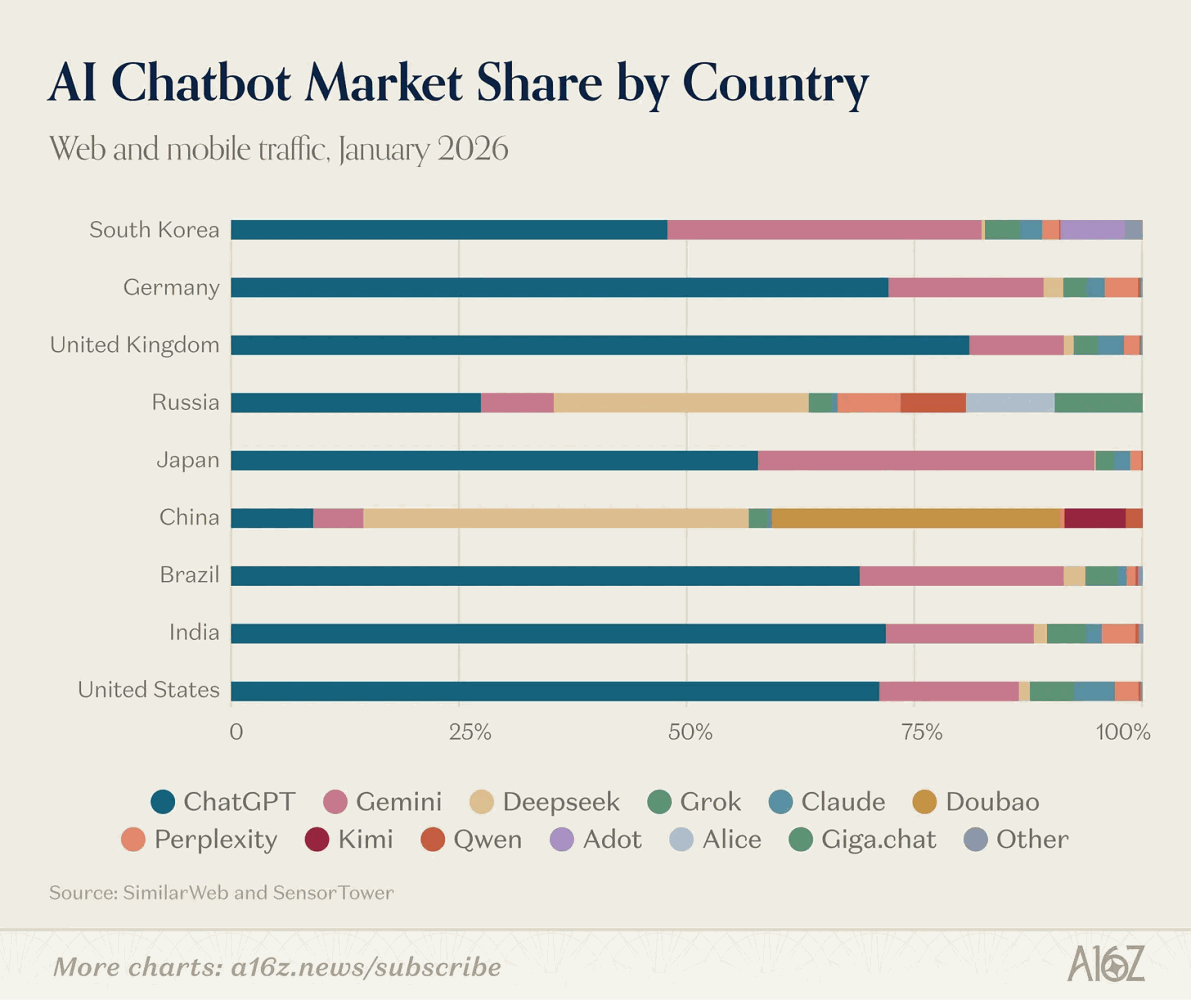
Western tools like ChatGPT, Claude, Gemini and Perplexity share virtually the same user base: the US, India, Brazil, the UK and Indonesia. None of them has significant traction in China or Russia.
DeepSeek is the only product that bridges the gap. Its traffic splits across China (33.5%), Russia (7.1%) and the US (6.6%).
Russia has become a third pole. Yandex Browser with built-in AI assistant Alice reached 71 million monthly active users. Sber's GigaChat debuted on the web list. Sanctions created the gap, local products filled it within two years.
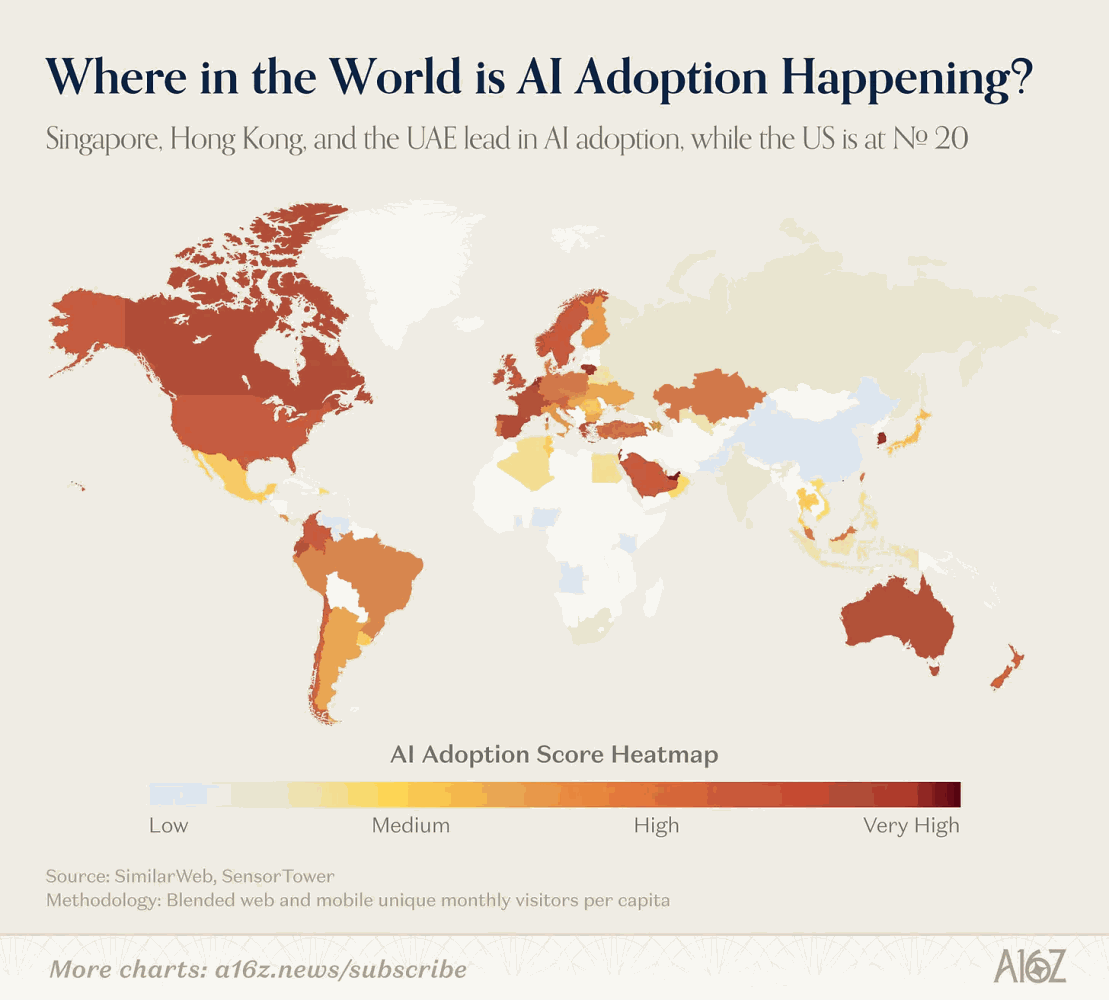
Based on AI adoption per capita, Singapore scores highest, followed by the UAE, Hong Kong and South Korea. The US, the country that produced most of these products, ranks only 20th.
Creative AI tools: from standalone to built-in
Midjourney, DALL-E and Stable Diffusion were the products that introduced the first wave of users to generative AI. All three appeared before ChatGPT. In the first edition of this list, seven of nine creative tools were image generators.
Three years later, only three remain.
But the total number of creative tools on the list stayed the same. The difference: video, music and voice filled the spots that image generation left behind.
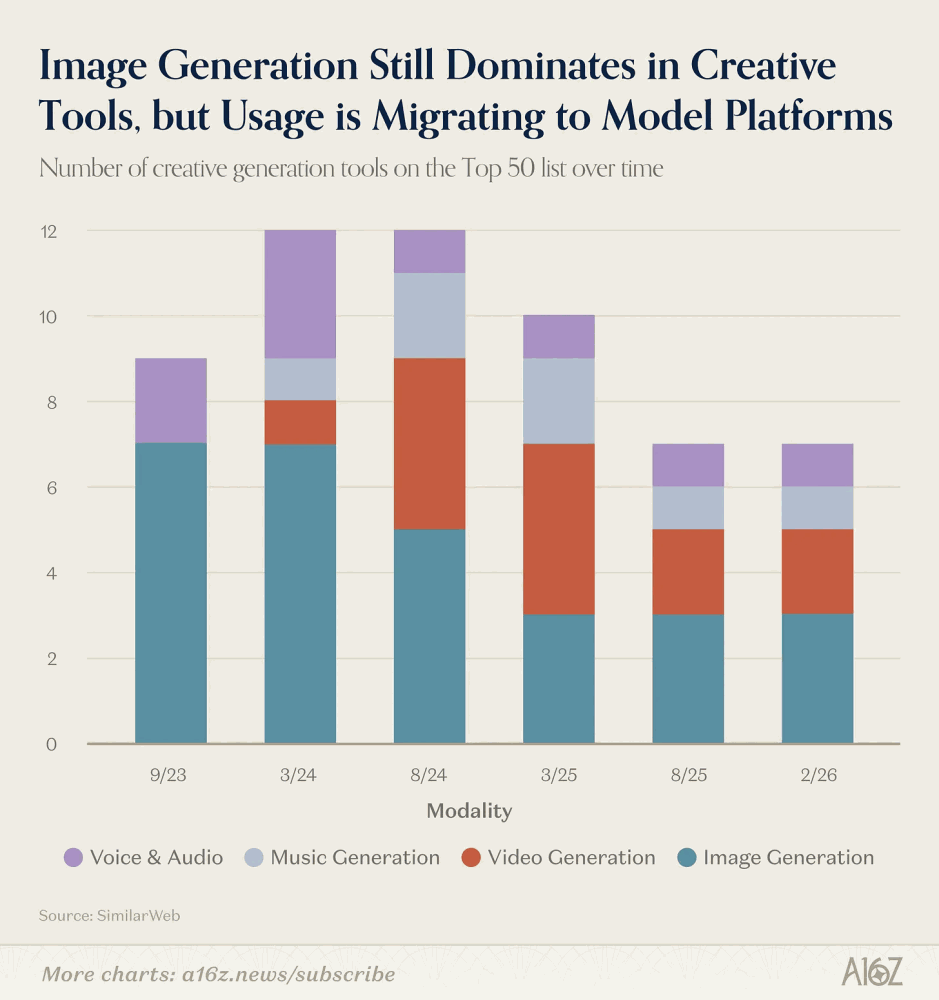
The image story is one of bundling. Now that the native image models of ChatGPT and Gemini are good enough, the bar for standalone products is much higher. Midjourney stood in the top 10 in the first edition, now at position 46.
Video sees the most movement. Kling AI, Hailuo and PixVerse built real traction, with Chinese models consistently leading in output quality.
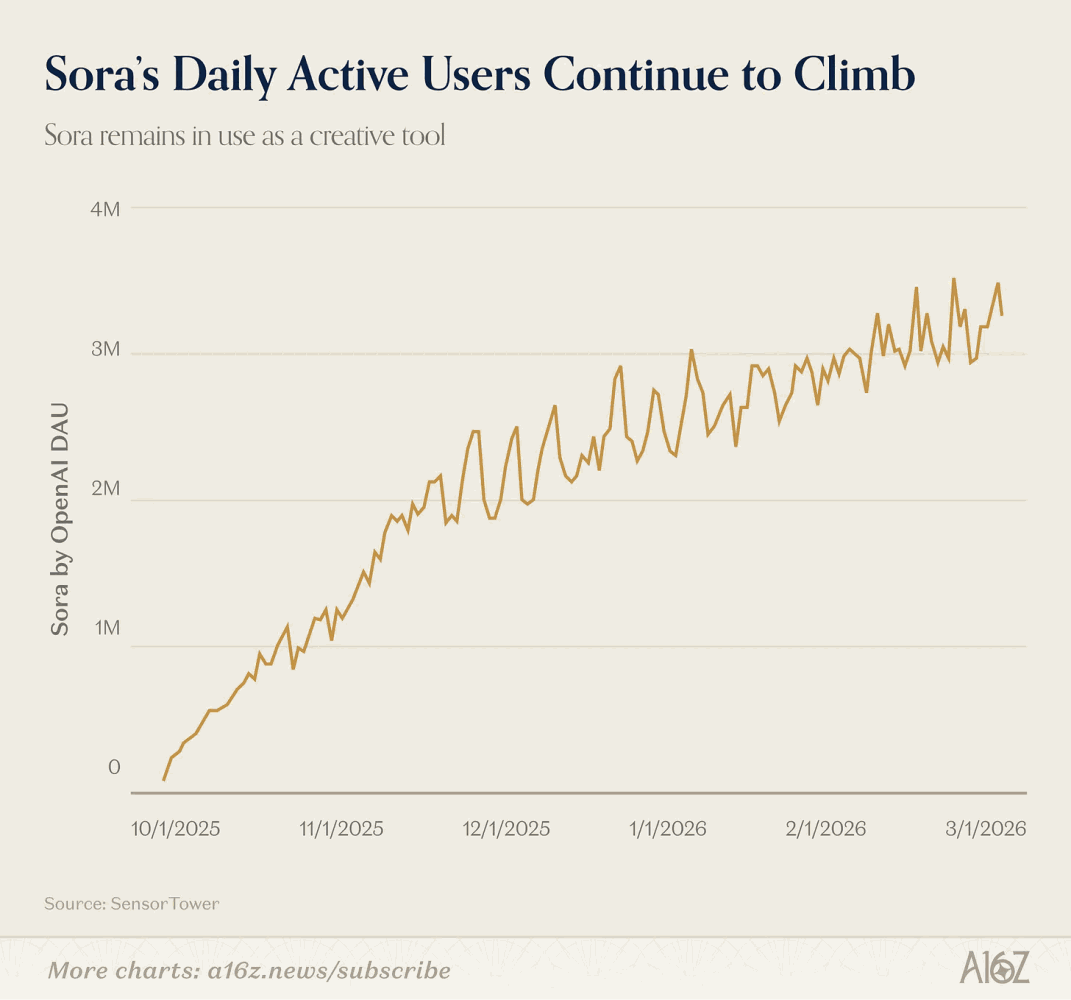
Notably absent from the mobile list: Sora. OpenAI launched version 2.0 in September 2025 as a standalone app. It topped the App Store for twenty days and reached a million downloads faster than ChatGPT. But then it declined. Sora failed to stay viral as a social app. Still, SensorTower counts over 3 million daily active users.
Music and voice turn out to be the most defensible. Suno kept its spot at #15. ElevenLabs has appeared in every edition since September 2023. Voice cloning and dubbing are too specialized to be built in as a side feature.
Agents: from 'buzzword' to reality
Buzzword — such a classic AI term, but Agents certainly were one.
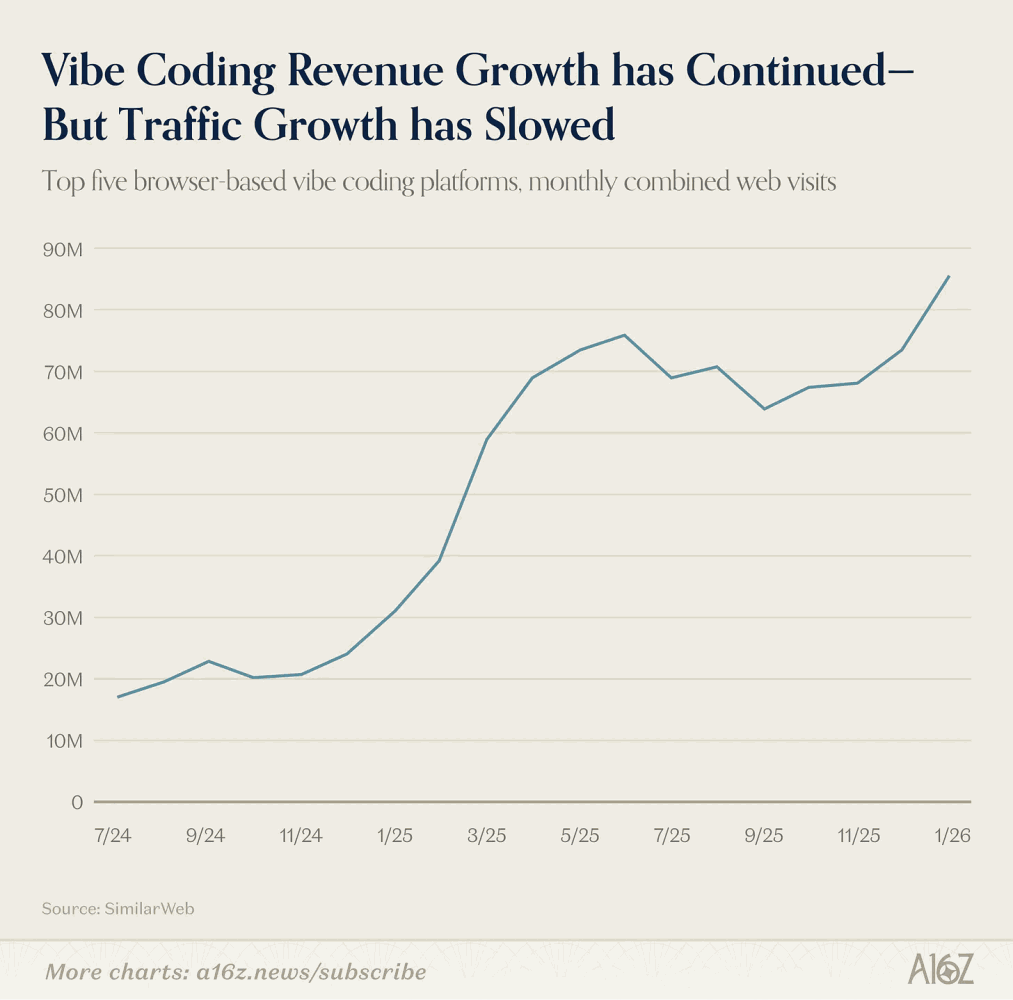
The shift toward agentic AI began last year with vibe coding. Lovable, Cursor and Bolt appeared on the March 2025 list as products that didn't just give answers, but built things on behalf of the user.
That trend continues. The combined web traffic to the top five vibe coding platforms grew from 20 million to over 85 million per month, even as growth flattens.
But the real breakthrough of 2026 is horizontal agents.
OpenClaw, an open-source project by Austrian developer Peter Steinberger, went from side project to 68,000 GitHub stars and broad media attention in January. It's a locally running AI agent that connects to your messaging apps and performs multi-step tasks on your behalf.
In March it became the most-starred project on GitHub ever, above React and Linux.
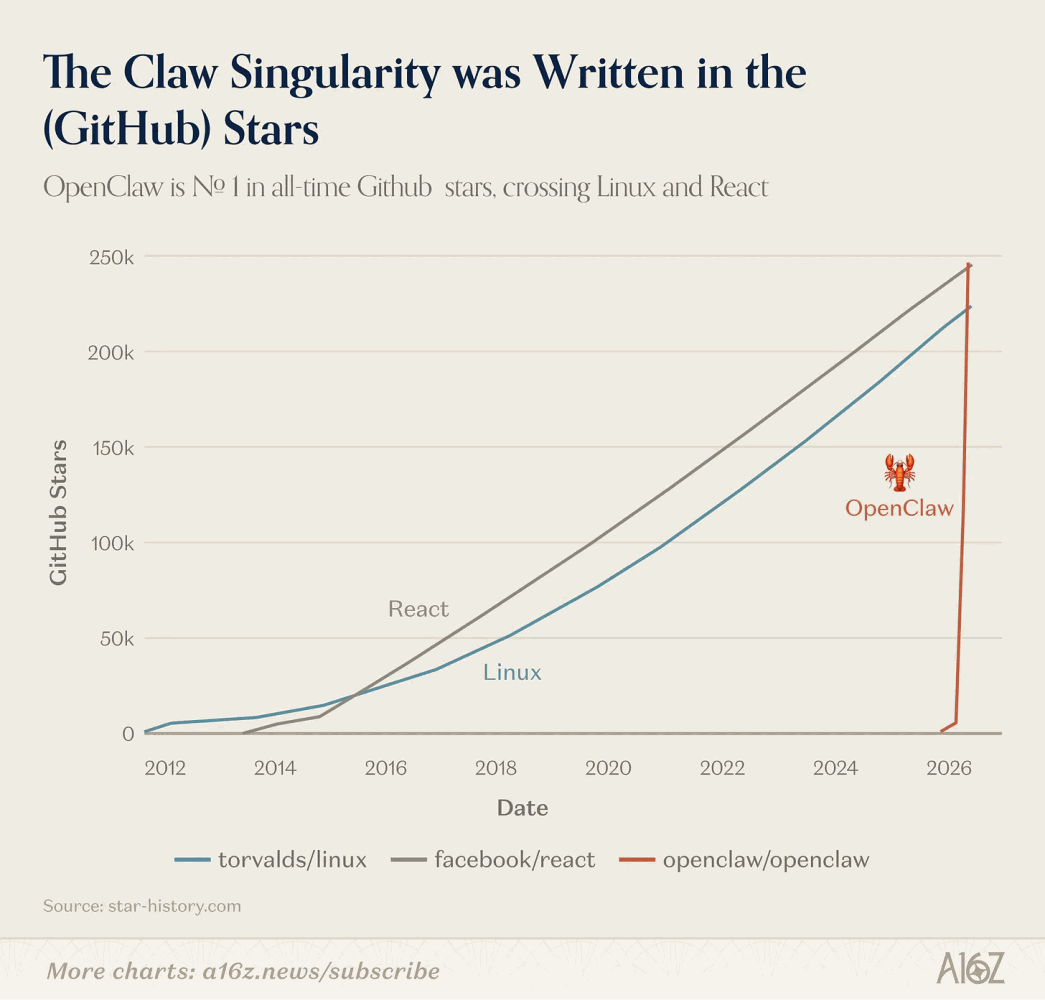
Yet OpenClaw isn't ready for the mainstream. You need Terminal knowledge to set it up. Visits to the signup page have remained fairly flat after the initial spike.
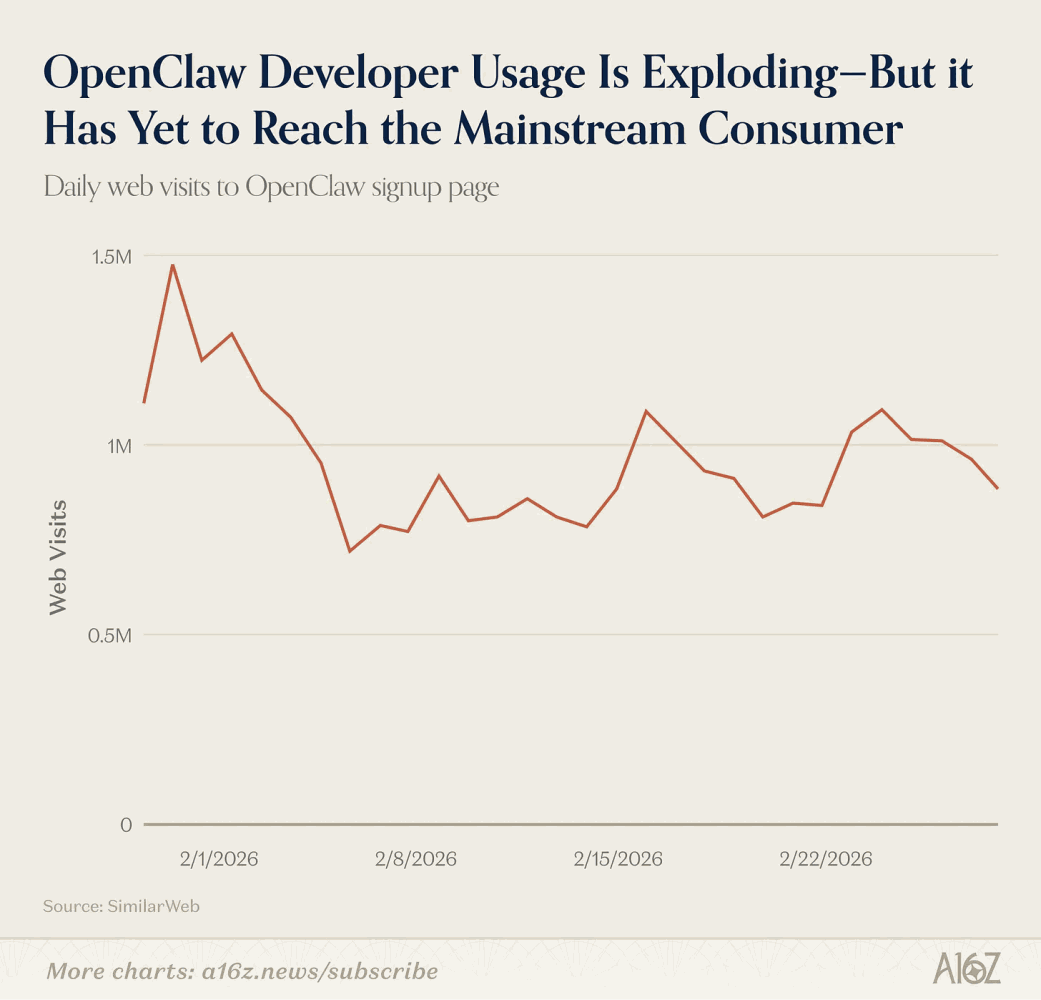
OpenAI acquired OpenClaw in February 2026 — pointing to a more accessible version in the near future.
Besides OpenClaw, Manus (acquired by Meta for about $2 billion) and Genspark ($300 million Series B, $100 million ARR) also made the list. Both platforms let consumers hand off open tasks — such as research, spreadsheet analyses or presentations that the AI handles end-to-end.
Conclusion
The sixth edition of this list shows a tipping point. AI is no longer a destination — it's becoming a layer in everything we do.
ChatGPT still dominates, but competition is growing faster. The battle is no longer just about the best model, but about who builds the best ecosystem. And while ChatGPT aims for the super-app for everyone, Claude digs in with the power user and the developer.
Meanwhile, usage itself is shifting. The most important AI growth of the past year took place in products that don't even appear in web or app statistics: Claude Code ($1 billion ARR in six months), AI browsers, desktop agents and tools built into Excel, Chrome and Gmail.