Blog · AI Startup
The Honest AI Startup Rollercoaster
Olaf Lemmens, Founder NinA AI Agency · April 11, 2026 · 7 min read
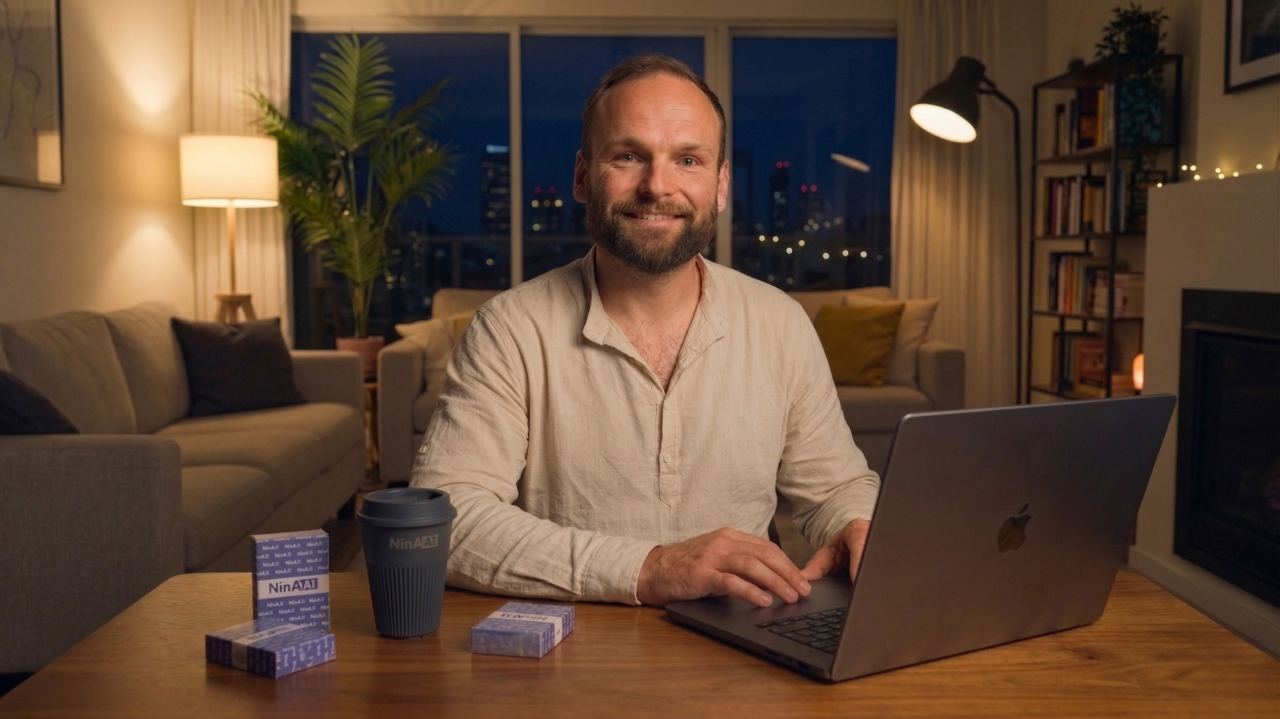
Thursday evening, 10:30pm. Kids in bed. House quiet. Laptop open on the couch.
I was re-reading the job posts one more time before they went live. Three openings. In the same week I looked at Q1 numbers and saw red for the first time.
This is the story I share on LinkedIn with some hesitation, but the charm of building in public is that you also show the other side of the coin. So today: rising costs, lagging revenue that then explodes, people coming and going, and stepping on the gas anyway. The real story of building a startup.
TL;DR
Q1 was our first loss-making quarter ever. Costs rose, revenue didn't grow fast enough. We're still ten people, but I know I can't hold on to everyone forever. And yet we posted three new job openings. Here's why.
The numbers never lie
Let me be honest: Q1 wasn't the quarter I had hoped for. Costs almost doubled compared to last year. Logical, because we grew from four to ten people. More developers, a project manager, more structure. That costs money. But revenue didn't grow at the same pace. Sales cycles in AI are long. Companies want to, but decision-making takes months. Meanwhile, payroll just keeps running.
For the first time in two years I looked at the numbers and thought: this is not enough. Not "We made a loss, things are going badly." But: "We invested in growth and the return comes with delay."
That sounds rational when you write it down. But when you sit on the couch at night looking at your bank balance, while the house is quiet and the kids are asleep, it feels different. Doubt creeps in. Did I scale too fast? Should I have been more careful? Are those ten people a sign of success or overconfidence?
Ten people. And the reality of a startup.
We're ten now. That sounds like a milestone, and it is. Three years ago I was alone behind my laptop. Now we have an office, a team of developers, a project manager, and more projects than ever.
But here's something few founders say out loud: you can't hold on to everyone. Not because you don't want to. But because a startup constantly changes. What someone needs and what the company needs don't always sync.
What I'm proud of: the core of the team stays. The people who've been here for more than a year, they stay. They grow with us. They feel ownership. They're not just employees. They're co-shapers of where we're going.
The market is shifting. And we feel it.
A year ago the most-asked question was: "Should we do something with AI?" Now it's: "How fast can you start?"
At NinA AI we feel that shift daily. The pipeline is fuller than ever. Three, four times a week I hear the same thing: "We should have started earlier." That's exactly why Q1 was an investment, not a loss.
Stepping on the gas when it gets scary
Eight days into Q2 we'd already recovered the costs of the entire previous quarter. Eight days.
So we're doing what I didn't dare in our difficult quarter but should have: we're posting three new openings. Not despite Q1. Because of what we see coming in Q2.
Five lessons from the rollercoaster
One: growth is not linear. Costs come first. Revenue follows. The period in between is uncomfortable. That's normal.
Two: the people who stay matter more than the people who leave. Invest in your core.
Three: you can't build for tomorrow with yesterday's team.
Four: dare to accelerate when it gets scary. Look at the data, not the feeling in your gut.
Five: talk about it. The loneliness of entrepreneurship is real. But it doesn't have to be.
We're looking for you
We're looking for three people. No theoreticians. Builders. If that sounds like you, check nina-ai.nl/vacatures.
We're ten. We're growing. And we're not stopping.
Until next time,
Olaf Lemmens
Founder NinA AI Agency