Blog · AI & Productivity
Are We Getting Dumber Because of AI?
Olaf Lemmens, Founder NinA AI Agency · December 13, 2025 · 6 min read
I caught myself doing it recently. I had to write a strategic document for a new client. A job where I normally sit down with a cup of coffee and a blank sheet of paper to structure my thoughts.
But not this time.
My first reflex was not "what do I think about this?", but "let me throw this into Claude". Within 30 seconds I had a decent structure.
And that's exactly where the danger lies. "Decent" is the enemy of "brilliant". And worse: I could almost physically feel my own brain activity decreasing. I wasn't thinking, I was managing.
Recent research shows that I'm not the only one who should be worried.
TL;DR:
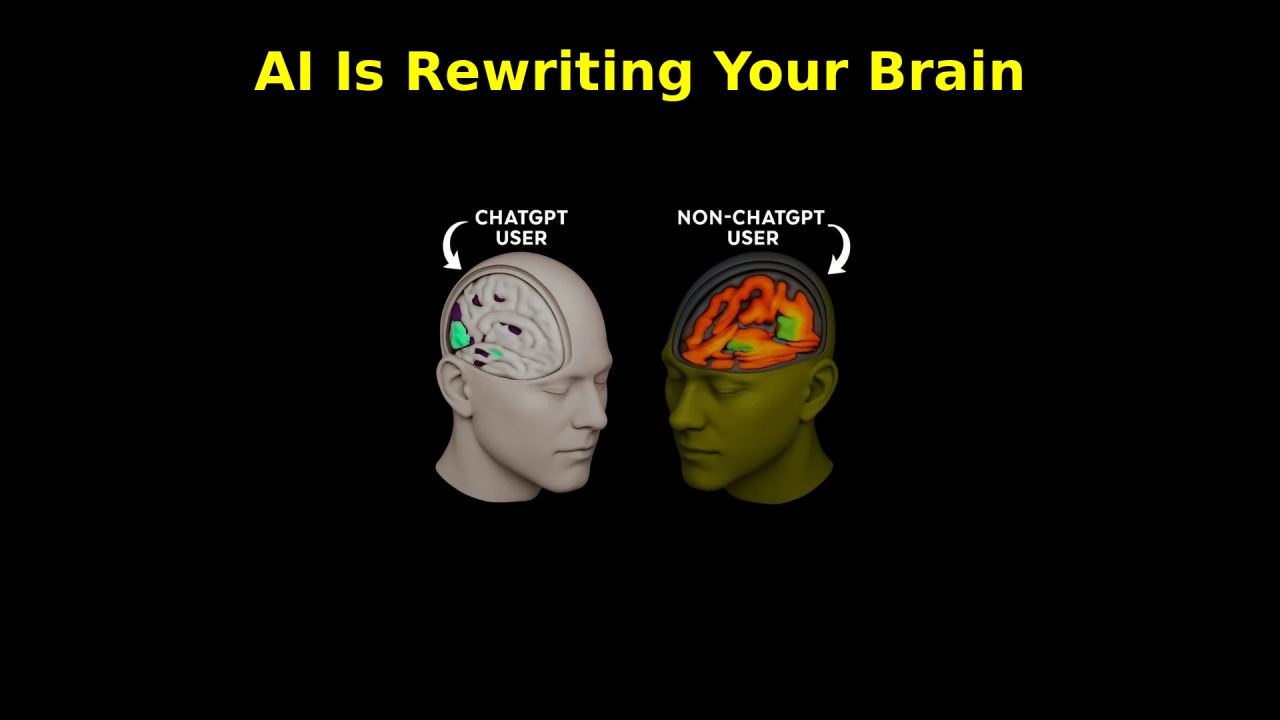
- •Cognitive Offloading: Research shows that excessive AI use leads to measurable reduction in brain activity ("use it or lose it").
- •The BCG Effect: Consultants who blindly trust AI on complex issues perform 20% worse than those who continue to think for themselves.
- •The Solution: "Think First, AI Second" – use AI as a sparring partner, not as a replacement for your intellect.
The "GPS Route" to Cognitive Atrophy
Remember how well you used to know your way around? Since we all have Google Maps, our sense of direction has evaporated. The hippocampus (the part of your brain for navigation) literally shrinks if you don't use it.
With Generative AI, the same thing threatens to happen to our critical thinking skills.
Scientists call this cognitive offloading. When we remove the "friction" of thinking (struggling with a formulation, structuring an argument), we no longer train our brains.
Preliminary EEG scan studies show that brain connectivity significantly decreases when people use AI to perform tasks instead of doing them themselves.
Even more shocking: research shows that 83% of people who had AI write a text could barely remember the content immediately afterward.
So you're not just getting lazier, you're also not storing the information anymore.
Why This Is a Business Risk
"Nice Olaf, that biological story, but does it make money?"
Yes. And it costs you money if you ignore it.
A groundbreaking study by Boston Consulting Group (BCG) showed there's a "Jagged Frontier". For creative ideas, consultants with AI scored 40% better in quality.
BUT... (and this is a big but):
In complex business problem-solving where nuance was required, consultants who blindly trusted AI performed 20% worse than the group without AI. They "fell asleep at the wheel". They stopped verifying and took the model's hallucinations for truth.
The Solution: Think First, AI Second
Does this mean we should stop using AI?
Of course not. That would be just as stupid as quitting the internet. At NinA AI Agency, we build agents daily that save companies hours of work. But the way you use it needs to change.
I recently adopted the "Think First" rule.
Before I type a single prompt, I force myself to write down the following (just in a notebook):
- What is my core message?
- What is the unique angle that only I can provide?
- What are the 3 most important points that need to be included?
Only when that rough structure is there – and my brain has done the heavy lifting – is AI allowed to develop, polish, or supplement it.
AI Is a Multiplier, Not a Replacement
If you multiply 0 by AI, the result stays 0. If you multiply your expertise (10) by AI, you get 100.
Use tools like ChatGPT, Claude, or your own custom agents in N8N to accelerate your thoughts, not to replace them. Stay the architect of your own work, and let AI be the contractor.
That way you stay sharp, and your results stay humanly good.
What do you think? Do you also notice that you're becoming "lazier" in your thinking because of AI?
Until next time,
Olaf Lemmens
Founder | NinA AI Agency
P.S. Want to implement AI that supports your teams instead of replacing them? We build systems where the human expert stays "in the loop". Schedule your introduction here.