Blog · AI Trends
This Was The Week In AI #36
Olaf Lemmens, Founder NinA AI Agency · June 22, 2026 · 6 min read
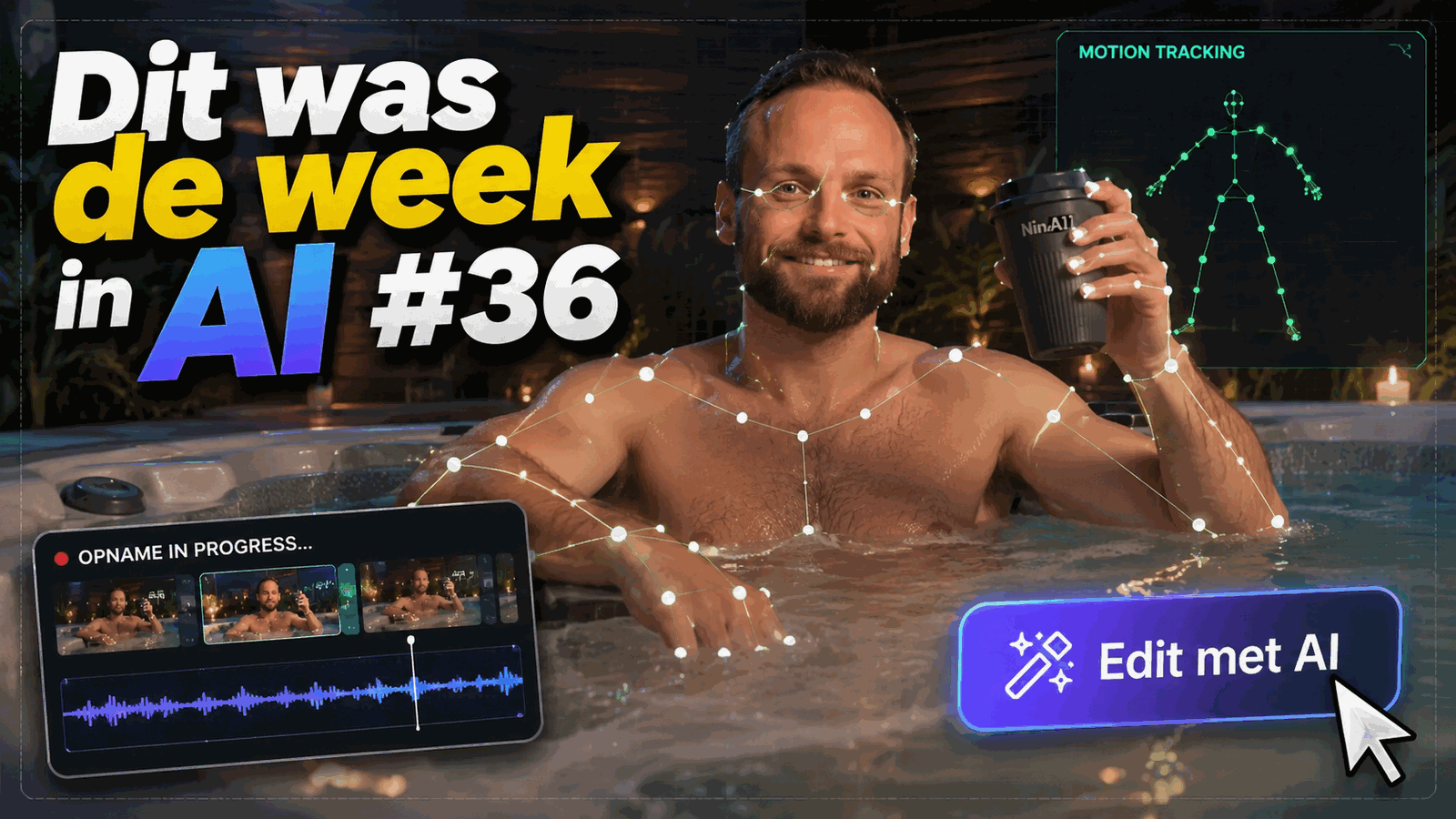
Last week was a bit quieter, but there were interesting updates all the same.
Four stories. Four completely different sectors.
This week an AI image generator announced medical scanners. A chipmaker built animation technology that makes decades of work redundant. A code assistant learned to take over tasks just by watching. And an open-source video editor entered the market where AI does not sit on top of the tool, but inside it.
In this newsletter we line up all four: what was announced, what it does and why it matters.
This was the week in AI #36.
TLDR;
Midjourney is building medical scanners into wellness spas
NVIDIA replaces game animation with one neural network
OpenAI Codex learns tasks by having you demonstrate them
The AI video editor is finally here
Imagine: you tell your video editor what you want, and it simply does it.
That sounds futuristic, but it exists now. Palmier is an open-source video editor for the Mac where Claude works directly in the timeline. Editing, organising, generating footage: all through AI.
Going open source means:
A first-class editing programme, and free at that
Semantic search across your media and full transcription of languages, right on your device
Using your own Anthropic API key or connecting through MCP
No separate AI plugin you stick onto your video afterwards. No cumbersome export-import loop. The AI sits in the editor, in the timeline. Or in other words: upload the footage in your Claude chat and use your prompt to say what you want done.
What strikes me here: this is exactly the approach that was missing. AI tools for video already existed, but always as a layer on top. Palmier flips that around. The editor was built because AI can now do this, not retrofitted after AI arrived.
Will this become the standard for creative software? I do not know. But the idea is sound: give AI control over the work surface itself, not just over a small corner of it.
For now: free to download, Mac only, open source. Worth a look if you edit video regularly.
Demonstrate it once and Codex takes the task over from then on
You walk a new colleague through a task. You demonstrate it, step by step. After that they do it themselves.
That is exactly how OpenAI Codex now works, but with AI.
You hit record, carry out your task the way you always do, and stop the recording. Codex saves those steps as a “skill” it can carry out itself from then on. Filing expenses, requesting leave, weekly reports: the tasks you always open with a sigh.
The clever part is in the details: the recording starts and stops on your command. Nothing is captured on the sly. And the skill Codex saves is readable and editable before it runs. Not a black box, but an adjustable set of steps.
What sets this apart from a macro or a script: you do not need to know how to program. You just do your work, the way you always did.
The scope is still limited for now. But the direction is clear: automation that does not start with a developer, but with the person who already knows the task.
Midjourney is now building... medical scanners
Yes, you read that correctly.
Midjourney, the company you know from AI-generated images, announced last week that it is building a medical scanner. Not a plugin and not a new model version, but an actual physical device.
How it works: you are lowered into a water bath, a ring of ultrasonic sensors scans your entire body, and after 60 seconds it is done. Founder David Holz claims it can compete with an MRI on detail.
The device was built together with Butterfly Network, a specialist maker of ultrasound chips. So not a hobby project.
In 2027 the first Midjourney Spa opens in San Francisco, with around 10 scanners alongside saunas, ice baths and hot tubs. A wellness day that also yields a medical check-up.
Now the nuance: there is still a lot to prove. Medical hardware is a completely different game from software. Regulation, clinical validation, liability. Holz says it reaches the detail of an MRI, but that is a bold claim that calls for independent evidence.
What I do find interesting: Midjourney apparently has a longer list of products in the pipeline. After this, the other “TBA” announcements on their site suddenly became a lot more intriguing.
An AI image company building spas with medical scanners. The world is strange.
One AI replaces an entire animation team
Animation in games is an eternal fight against unnaturalness.
Animators manually build hundreds of movements, write rules for transitions, solve foot placement, debug state machines. Step by step, movement by movement. Years of work for one character.
NVIDIA’s MotionBricks does it differently. One neural network, trained on 350,000 motion clips, generates all movements in real time. You say: “Walk over there, jump over that couch, sit down, but in zombie style.” The model handles foot placement, balance, transitions and follow-through itself. No handmade animations. No blending rules. No state machines.
It runs at 15,000 frames per second with 2 milliseconds of latency, live in Unreal Engine 5.
But the bigger story is not in games.
NVIDIA has already integrated MotionBricks into their GR00T stack: the technology that drives humanoid robots in research labs worldwide. The same AI that makes a game character walk in zombie style is now teaching real robots to make human movements.
That is the step that stands out here. From virtual character to physical robot, with the same technology. The line between animation and robotics is shifting.
Presented at SIGGRAPH 2026, so this is not a concept video. This is running now.
My take
Honestly: the Midjourney story will not leave me alone.
Not because I am sure it works. But because it shows how quickly the boundaries blur around what an AI company “is”. Midjourney is an image generator. Was an image generator. Now they are building water-basin scanners and opening spas.
That is not a small side track. That is a fundamentally different company strategy.
And I hear the same from entrepreneurs and investors in my network: the question “what does this company actually do?” is getting harder and harder to answer for AI players. NVIDIA started as a chipmaker for gamers. Now they drive humanoid robots in research labs. OpenAI started as a safety lab. Now they build office automation for people who never learned to program.
MotionBricks is a good example of that. The announcement sounds like a gaming story. But the real application is in robotics. Two markets, one technology, presented at an animation conference.
That is the pattern I see this week: AI companies no longer stick to the sector they were founded for. They move to wherever the technology takes them.
The question is no longer which AI company is going to touch your sector. The question is when.
Until next time,
Olaf Lemmens
Founder NinA AI Agency
P.S. Want to talk through how AI could work in your organisation? Or how tools like these could save you time in your work? Book an intro call through this link.