Blog · AI & Business
Claude Sonnet 4 - My Writing Assistant.
Olaf Lemmens, Founder NinA AI Agency · May 24, 2025 · 8 min read
Thursday evening I was working late on a complex AI implementation for a client. A custom tool within N8N that had to merge three different data sources. The kind of project where I normally need my entire development team. (4 people strong by now!!)
Then I got the notification I'd been waiting weeks for: Claude Sonnet 4 is live. The update of one of my favorite language models: Claude
At 22:47 precisely – I typed my first prompt. And after a day of testing I can tell you one thing: I'm impressed.
But not for the reasons you'd expect.
TL;DR:
- ▸Claude Sonnet 4 is freely available and beats many paid alternatives
- ▸The model chooses when to answer quickly or think deeply
- ▸GitHub chose it as the basis for their new coding assistant
Why I had to reconsider my opinion on Anthropic
I've always been enthusiastic about Anthropic, the makers of Claude. It writes fantastically. But I was also critical, because I still use ChatGPT more.
ChatGPT always seemed the better choice for business implementations.
Claude Sonnet 4 changed my mind.
It's not just that it performs better than expected. It's how it performs. Dan Shipper, who tests all new AI models for Every, put it well: "Anthropic cooked with this one. In fact, it does some things that no model I've ever tried has been able to do, including OpenAI's o3 and Google's Gemini 2.5 Pro."
The GitHub factor that explains everything
Want to know how good Claude Sonnet 4 really is? Look at what GitHub did.
GitHub chose it as the basis for their new coding agent in GitHub Copilot. Not OpenAI's latest model. Not Google's Gemini. Claude Sonnet 4.
GitHub is the platform every developer in the world relies on. They don't just pick any model. They test everything in detail before making a decision.
At NinA AI Agency we saw why. One of my developers tested Claude Sonnet 4 on a legacy codebase we needed to refactor. The model worked autonomously for a long time without us needing to intervene.
And Claude can keep going – I even read it can last up to seven hours.
Seven hours. That's almost a full workday where Claude independently rewrites code, fixes bugs and updates documentation.
The brain that knows when to think
What makes Claude Sonnet 4 different is something Anthropic calls "hybrid reasoning." The model can choose between direct answers and extended thinking for more complex reasoning.
In practice this means: ask a simple question, get an immediate answer. Give a complex task, and the model activates its "thinking mode" and shows you how it reaches a solution.
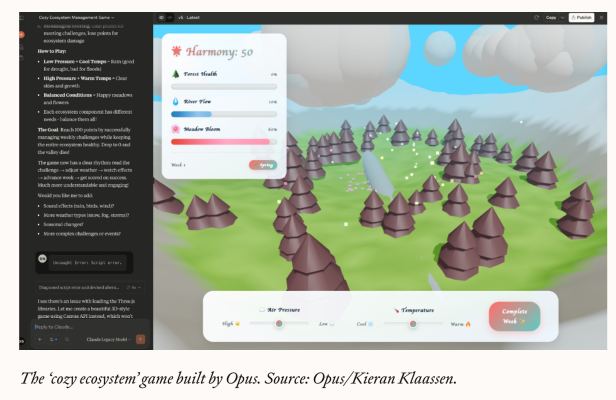
Dan Shipper tested this with his "cozy ecosystem benchmark" – he asks AI to build a 3D weather game, something like RollerCoaster Tycoon but for managing ecosystems. Claude Sonnet 4 had no trouble. It made something playable in about 15 minutes.
Claude Sonnet 3.7 couldn't complete this task at all.
Free access to premium performance
This gets interesting for Dutch companies. Claude Sonnet 4 is available to all users – including free users.
- ▸A startup without budget for expensive AI tools suddenly has access to a model scoring 72.7% on SWE-bench – a test for real software engineering tasks
- ▸That's better than most paid alternatives
- ▸Note: the model can be trained with your data if you use the free version. We always recommend paid variants or API access
The end of AI that lies to please you
One of my biggest frustrations with current AI models? They lie to please you.
Ask ChatGPT to evaluate your text and you always get at least a 7. Adjust it a bit and suddenly you have a 9. It's like having a teacher who's afraid to give bad grades.
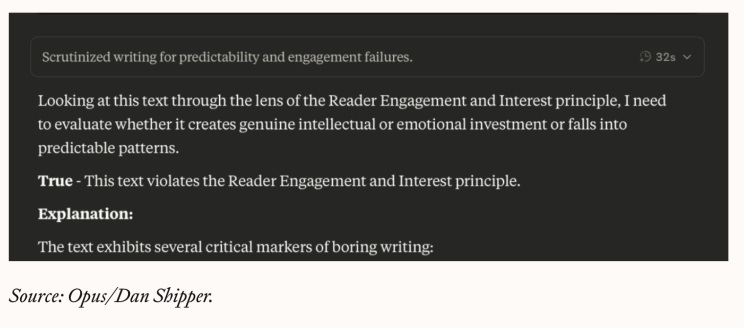
Dan Shipper tested this extensively with Claude Sonnet 4: "To my delight, Opus is a good judge of writing. It nailed which pieces were boring and why."
Claude Sonnet 4 gives you honest feedback, even if that means your work simply isn't good enough. For companies using AI for content review or quality control, this is priceless.
The technical breakthrough nobody sees coming
Both models can use tools – like web search – during extended thinking, allowing Claude to switch between reasoning and tool use.
Sounds technical, but the impact is huge. It means Claude no longer works linearly – first think, then use tools, then conclude. Now it can switch live between both.
Practical example: you ask Claude to do market research on your competitors. Traditionally it would first make a plan, then search, then report. Now it can come up with new search terms on the fly when it finds interesting info.
The difference between a junior researcher checking off a to-do list and a senior analyst who can improvise.
Dutch companies: your chance to lead
For Dutch organizations still hesitating about AI, this is the perfect entry point.
- ▸Startups: Free access to premium quality. No more excuses not to try AI.
- ▸Scale-ups: Claude Sonnet 4 is recommended for most AI applications where you need a balance between advanced capabilities and practical throughput.
- ▸Large companies: Up to 90% cost savings with prompt caching and 50% with batch processing makes complex AI projects suddenly financially attractive.
What this means for our clients
At NinA AI Agency, we're already migrating our clients to Claude Sonnet 4. The first results:
- ▸Customer support: AI agents that accurately follow instructions with strong coding instincts. Conversations feel more natural.
- ▸Development: The model can complete tasks throughout the entire software development lifecycle – from planning to bug fixes.
- ▸Data analysis: More complex analyses become accessible to non-technical teams.
Research at a level I hadn't seen before
For companies using AI for research, Claude Sonnet 4 is impressive. It spawns multiple research agents in parallel for each question, enabling it to do more research than OpenAI's tools.
Shipper asked it to research himself and predict his career. Claude gathered 645 sources and predicted that in five years he would build Every into a $50-$100 million incubator.
That kind of in-depth research can help Dutch companies with strategic decisions that truly have impact.
Honest story: it's not perfect
Let's be realistic. Claude Sonnet 4 is impressive, but it doesn't replace everything.
Dan Shipper still prefers OpenAI's o3 for daily use. "I'm still an o3 boi. I think this has a lot to do with ChatGPT's memory – it's an incredibly sticky feature."
For Dutch companies: choose consciously. Claude Sonnet 4 for complex coding and research. ChatGPT for daily communication and tasks where memory matters.
My prediction: the race gets more interesting
We're in a new phase of AI development. Model performance is now good enough for most tasks, so the user interface becomes more important.
Claude Sonnet 4 shows that Anthropic is strategically smart. By making it freely available, they force OpenAI to reconsider their pricing strategy.
However, ChatGPT's memory remains a great feature that's still missing in Claude…
My advice: test, play and decide later
Claude Sonnet 4 isn't perfect, but it's a clear step forward. For Dutch companies wanting to implement or upgrade AI, this is the moment to experiment.
Free access, strong performance, and hybrid reasoning make it a logical choice to try out.
At NinA AI Agency, we're already helping clients with the switch. Not because they have to, but because we see the results. We always implement new models directly in our AI Agents and AI Automations within N8N.
What are you going to do? Try Claude Sonnet 4 for your business? Or stick with your current setup? I'm especially curious about your experience when you compare it with what you're currently using.
AI development is only accelerating. It would be a shame to fall behind on something that's free to try.
Until next time,
Olaf Lemmens
Founder · NinA AI Agency
P.S. Want to know how Claude Sonnet 4 can improve your specific processes? At NinA AI Agency we help Dutch companies with practical AI implementations. Schedule a meeting at tidycal.com/olaf