Blog · AI & Business
My Project Manager Said: "If You're Sick Tomorrow, We Lose Everything"
Olaf Lemmens, Founder NinA AI Agency · March 28, 2026 · 12 min read
Yesterday afternoon I was in my sixth meeting of the day. A discovery call with a hotel chain, a one-on-one with my project manager, a kick-off with a new enterprise project. In between, an introduction with a tourism organization.
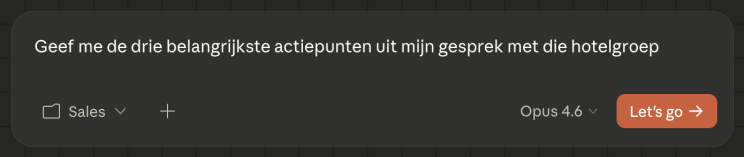
At 5pm I opened Claude, typed "give me the three most important action items from my conversation with that hotel group" and within ten seconds I had a summary that was better than my own notes.
That's my Thursday. And it works fantastically.
For me.
That's exactly the problem.
TL;DR
- ▸Personal AI tools work great but don't scale in a team
- ▸The step from "I use AI" to "my business runs on AI" requires workflows, not chat windows
- ▸N8N workflows make AI processes visual, self-hosted and transferable
- ▸The pattern: automate the repetitive, shift people from executor to controller
How it started: copy and paste as a business model
Two years ago I wrote sales proposals by quickly typing keywords in my notes app during meetings. Afterwards I'd work those notes into proposals. Sometimes the same evening, more often three days later. By that time half the nuance was gone.
The result: proposals that were "okay." Not proposals that made the client feel truly understood.
Then came the first transcription tools like MeetGeek and Fireflies (and many others). A huge improvement.
But I was still copying and pasting transcripts.
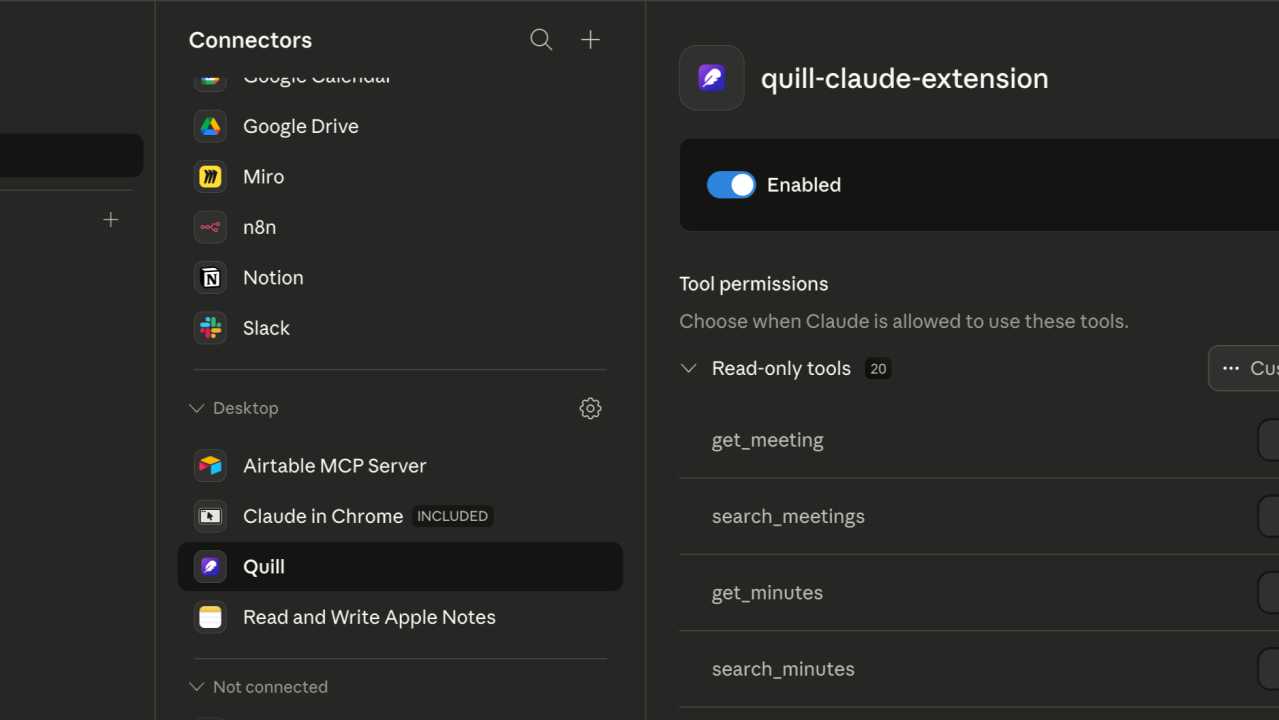
Then I discovered Quill. A tool that transcribes, summarizes and makes all my conversations searchable. You can chat with it directly, even during a meeting.
Valuable in itself.
But the real breakthrough came when I connected it to Claude.
My setup
My current workflow looks like this:
I have a conversation. Quill runs alongside, creates a transcript and automatically generates minutes. After the conversation I open Claude with an MCP connection to Quill. That means: Claude can read directly from my transcripts.
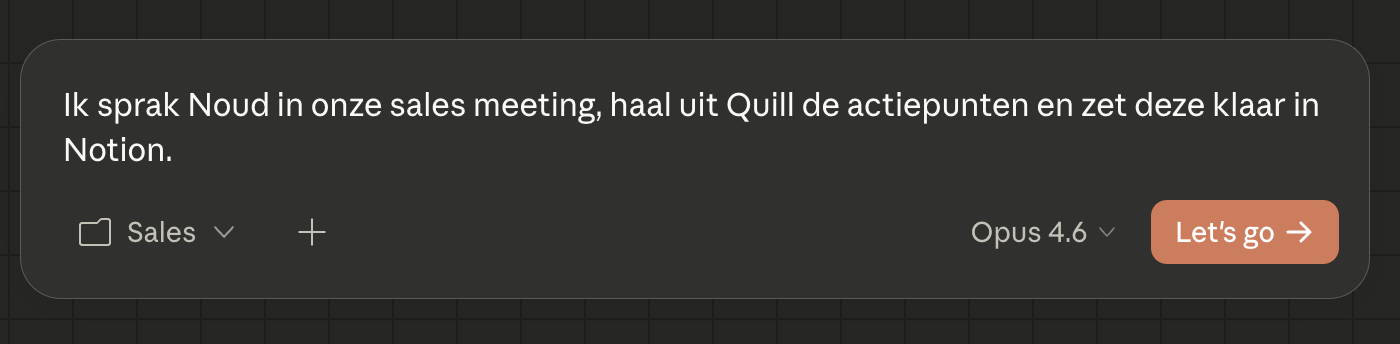
Then I ask things like:
- ▸"Write a sales proposal based on my discovery call with that hotel group"
- ▸"What were the three biggest pain points the general manager mentioned?"
- ▸"Create a LinkedIn post about the insights from my conversation with that healthcare organization"
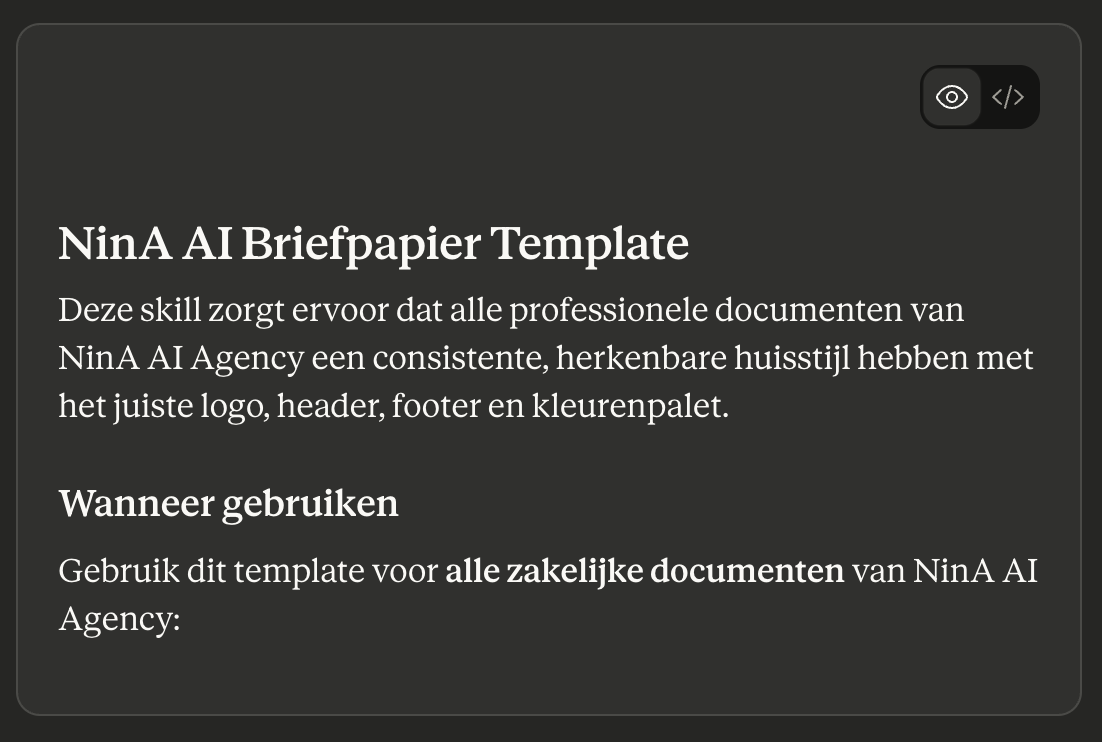
Claude grabs the transcript, extracts the relevant fragments, and produces output in our brand style. Because I've added that brand style as a "Skill" to Claude: our colors, our tone of voice, our letterhead. Everything I generate immediately looks like it comes from NinA AI.
It saves me hours every week.
But here's the thing: the real advantage isn't the time. It's the quality. My proposals are better, my follow-up is faster, my content is more relevant.
I felt invincible. Until last week.
"If you're sick tomorrow, we lose everything"
I was in a one-on-one with my project manager Janique. We were discussing how to go from fifteen to a hundred clients and how to adapt our processes for that now. It was about the things that always make me happy: processes, who does what, where information lives. And then she said it.
"This works great for you, Olaf. But if you're sick tomorrow, nobody has access to that information."
Silence.
She was right. All my client insights, all those transcripts, all that sales intelligence: it was in my personal Claude environment. My developers didn't know what was discussed in a discovery call. Sales had no visibility into what delivery had already accomplished. Even the context from a client conversation last week was unreachable for the rest of the team.
We had a gold mine of information. But it was on my desk, not in the organization.
And that's exactly the trap I see almost every entrepreneur fall into.
The trap: your AI tool is not your business
This is where most companies get stuck. They discover a tool that works fantastically for them personally (ChatGPT, Claude, Copilot, you name it) and think: "This is the solution." They become faster, smarter, more productive.
But a tool that works for an individual is fundamentally different from a system that works for an organization. Especially as you grow. With five clients you can keep everything in your head. With thirty, not anymore. And with a hundred, it's impossible.
This week I spoke with a healthcare organization of 230 employees. Exactly the same pattern. They have a project group that works cleverly with Copilot and ChatGPT. But the knowledge stays in silos. The smart solutions of one colleague don't reach the other. And the "old guard" who once saw a disappointing result has written it off permanently. "See, AI doesn't work."
An organization deals with multiple people who need the same information, processes that must run consistently regardless of who's working, data that needs to be centralized instead of in someone's head, and quality control that doesn't depend on an individual.
The step from "I use AI" to "my business runs on AI" is the one that makes the difference. And you don't make that step with a chat window. You make it with workflows.
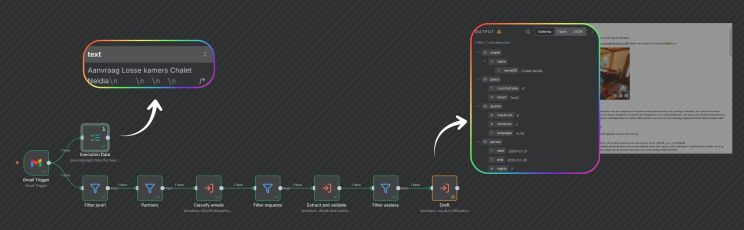
That's why we build everything at NinA AI in workflows, primarily with N8N. Not because it's the only option, but because it does three things that no other platform combines as well:
It's visual. When I show a client how their process works, I don't need to show code. I show blocks. "Here an email comes in. This block reads the content. This block sends it to the right person." Clients understand it immediately.
It's self-hosted. Our clients' data is on servers in Amsterdam, not at an American company. That healthcare organization I spoke to? GDPR restrictions make it impossible to send client data to external tools. With local servers, that's no longer a problem.
It's exportable. Every workflow is a JSON file. If a client decides to leave tomorrow, we export everything and hand it over. No vendor lock-in, no process hostage-taking.
What this looks like in practice
That realization with Janique was the starting signal. We're now converting everything I do personally into workflows the whole team can use. Client information centralized in our CRM, project setups that automatically create when a deal is set to "won," and Slack notifications that keep everyone informed.
But we're not just building this for ourselves. We do exactly the same for our clients. Let me give two concrete examples from this week.
Example 1: AI receptionist for an international hotel group
This week I had a discovery call with a hotel that's part of a group of 120 locations. Their problem is one I now recognize at every hotel chain: the reception is overwhelmed by repetitive questions via phone and email.
Our approach:
- Phase 1: AI answers the most common FAQ questions via phone and email
- Phase 2: Connection to the booking system for real-time restaurant reservations
- Phase 3: Omnichannel deployment — phone, email, chatbot and WhatsApp from the same knowledge base
We deliberately start small. Not with all 120 hotels at once, but with a pilot at one location. Stabilize, learn, then scale up.
Example 2: From database to SaaS platform
This might be the most common pattern lately. Companies (or smart individuals within companies) who built something with AI themselves. A new product they want to roll out, internally and externally. Running on their own valuable data.
There's the problem. You can build amazing things, but is it secure? Is there accidentally an API key in the code? And how do we handle the data safely?
That's why we're now converting proof of concepts into secure platforms for multiple parties. With login and everything included.
The pattern (and it starts with yourself)
My Quill + Claude setup, a quality control AI at a manufacturer, the AI receptionist at the hotel group, an AI platform for construction: it's all the same story. Someone does something manually, discovers it can be smarter, and then the real question comes: how do you make this bigger than yourself?
- Step 1:Someone does manual work that doesn't actually need to be manual.
- Step 2:We build a workflow that automates the repetitive part.
- Step 3:The human shifts from executor to controller.
- Step 4:The data that emerges becomes the basis for better decisions.
Nobody loses their job. Everyone gets a better job.
What you can learn from this (even without an agency)
You don't need an AI Agency to apply this. The principles are universal. And they all start with the same question: what happens if you're not there tomorrow?
Start with yourself, but don't stop there. Use a tool like Claude or ChatGPT to improve your own work. But as soon as it works, ask yourself: can someone else take this over? If not, you have a personal hack, not a business process.
Document what you do. As soon as something works for you, write down how it works. Not for a manual, but so someone else can take over. The step from "it's in my head" to "it's in a system" is the step from freelancer to organization.
Choose visibility. Whether you use n8n or something else: make sure your processes are visual and transferable. A workflow that only you understand is not a workflow. It's a personal habit.
Keep the human in the loop. Not everything needs to be 100% automated. The power is in 80% automation with 20% human control. That last bit is where the trust lies, both internally and toward clients.
Think in data, not in tools. Tools come and go. Data stays. Make sure everything you automate generates data you can use later. Every checked label, every answered guest question, every processed risk inventory: it becomes a dataset that makes systems smarter.
What's planned for next week
We're running ten sales calls this week. Ten. The market is moving fast. And a notable detail: clients are now finding us not only via LinkedIn or Google, but even through searches in ChatGPT. I wouldn't have expected that a year ago.
We're working on a standardized "AI Starter" product. A business scan that identifies three to five automation opportunities, plus the direct deployment of the first workflow. Tangible results within two weeks, not a consulting report that ends up in a drawer.
Why am I sharing this? Not to sell (although: if you're interested, DM me). But because I believe that transparency about what we build, how we build it, and what it costs is the best way to mature this market.
There are too many parties selling "AI transformation" without making concrete what that means. I want this newsletter to be the opposite: specific, honest, and useful.
Until next week.
This is AI Startup Stories, the weekly newsletter about building an AI Agency in the Netherlands. Every edition I share what we learn, build and do wrong. No theory, just reality.