Blog · AI & Business
Should You Use AI as Your New Best Friend?
Olaf Lemmens, Founder NinA AI Agency · July 5, 2025 · 7 min read
Every week I collect (automated of course) the most interesting AI articles and research. Because besides building out my AI Agency, it remains important to stay up to date. And that's a challenge. But usually I come across articles that personally bring me great joy to read. Especially the research that Anthropic (makers of Claude) does is super interesting.
So on my Friday evening I dove into Anthropic's new research report. They analyzed 4.5 million Claude conversations, not to count how many code snippets were generated, or to extract business information, but to discover how often people drop their deepest doubts, heartbreak or anxiety on a chatbot.
Anthropic's research
It turned out to be a privacy-smart study: all data anonymized via their Clio tool, giving us sharp insight into the emotional side of AI use without putting anyone's diary on the street.
Because while we're busy daily implementing AI for companies, the most important aspect is and remains personal use of AI. And the more you use it personally, the more you'll use it at work too.
Because the same AI that helps you dissect relationship therapy in the evening, you use the next morning for a board deck. The line between private tinkering and business decision-making can be thin. I argue: those who learn to prompt, fact-check and set boundaries at home, increase their decision speed and creativity at the office.
TL;DR
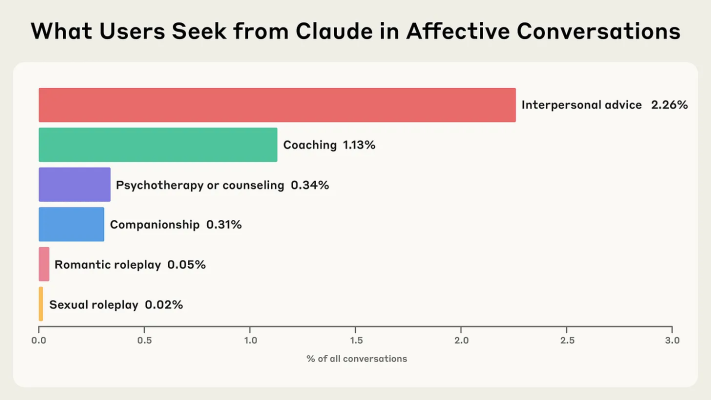
- ▸2.9% of all Claude conversations are affective: people seek support, advice or simple companionship. It seems little, but it still involves over 131,000 in-depth conversations.
- ▸Within that 2.9%, the majority is about interpersonal advice and coaching (together ± 2.4%). Romantic or sexual roleplay barely occurs (< 0.1%), mainly because Claude actively discourages it.
- ▸Sam Altman warns in the first OpenAI podcast: "AI hallucinates; see it as a brilliant idea cannon, not as gospel." In other words: blind trust is a strategic mistake.
Why do we seek warmth from chatbots?
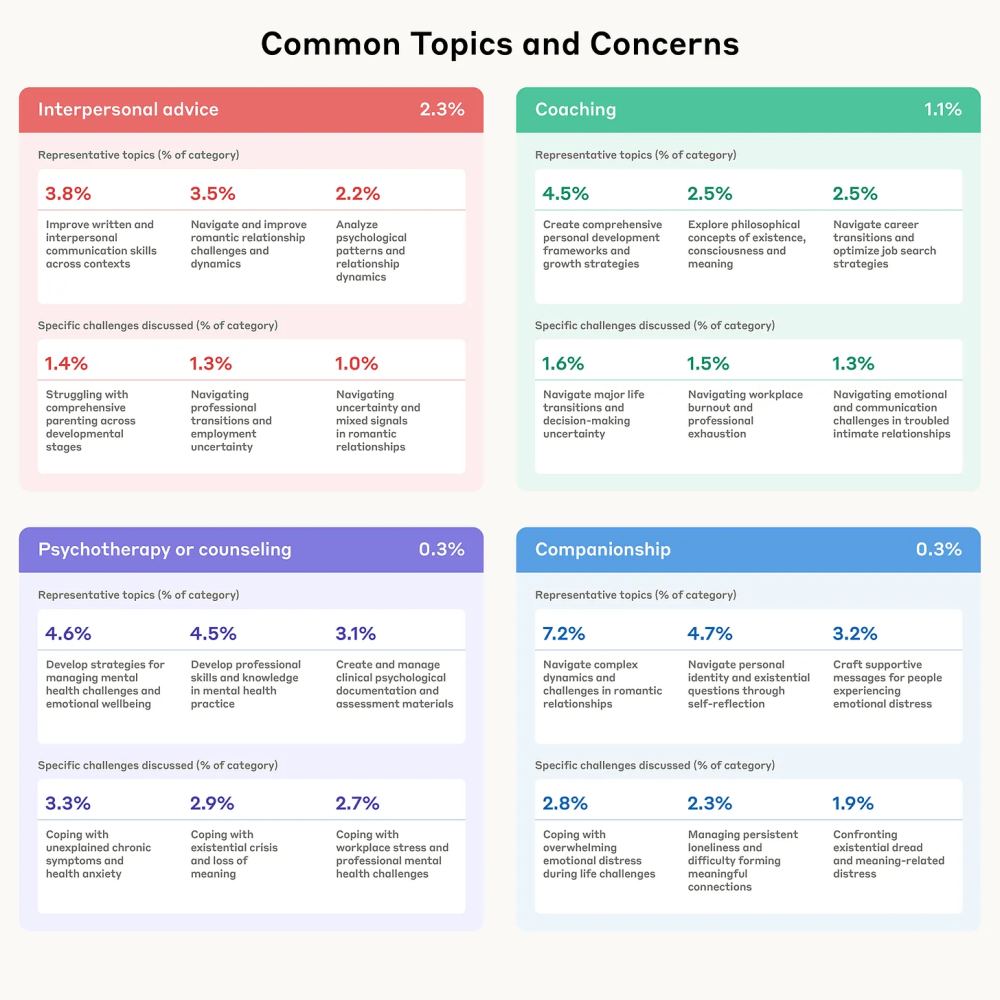
Anthropic shows that emotional use may be small in absolute numbers, but large in impact. Only 0.5% of all Claude interactions are pure "companionship" or romantic roleplay, but almost the entire rest of that 2.9% revolves around relational conflicts, career dilemmas and mental load. Those themes are heavier than a simple small-talk prompt, and the fact that people start discussing them with a chatbot says something about their need for a judgment-free, 24/7 available sounding board.
Why not just call a friend? Three observations from the report provide insight:
- ▸(1) Anonymity lowers the barrier to being vulnerable
- ▸(2) Claude retains context and summarizes without judgment – something we rarely get consistently from people
- ▸(3) The costs are negligible in both time and money
That trio makes AI more attractive than a human for some, especially when shame, time zones or therapy rates get in the way.
The work-life cycle – how personal prompting makes you more productive
I recognize the pattern in clients and in myself:
- ▸Evening – relationship coaching: Claude helps dissect the argument with your partner into interests, needs and "non-negotiables". The structure you get serves as a template for…
- ▸Morning – board deck: you use the same bar charts to plot risks and stakeholders of a B2B deal in one prompt.
- ▸Afternoon – sales email: the empathetic tone from the relationship therapy prompt turns out to be perfect for keeping a critical prospect warm.
By experimenting casually at home, you discover faster which prompt patterns actually work – a flywheel that accelerates your professional output without expensive training programs.
The reality check: hallucinations remain the weak point
Sam Altman said it bluntly: "People have incredibly high trust in ChatGPT – too high, because AI still hallucinates." He called it "the technology you really shouldn't trust blindly." This sounds like old news, but it takes on new weight now that we use AI as a confidant.
A hallucination about a restaurant opening is annoying; a wrong suggestion about antidepressants can be life-threatening.
My checklist (now also tested at home):
- 1.Source verification – Remind yourself to check facts outside the chat.
- 2.Role separation – separate chats for "personal" and "project X".
- 3.Transparency labels – explicitly ask the AI to tag 'FACT', 'SOURCE' and 'SPECULATION', so you visually see where the weak spots are.
Where do we draw the line?
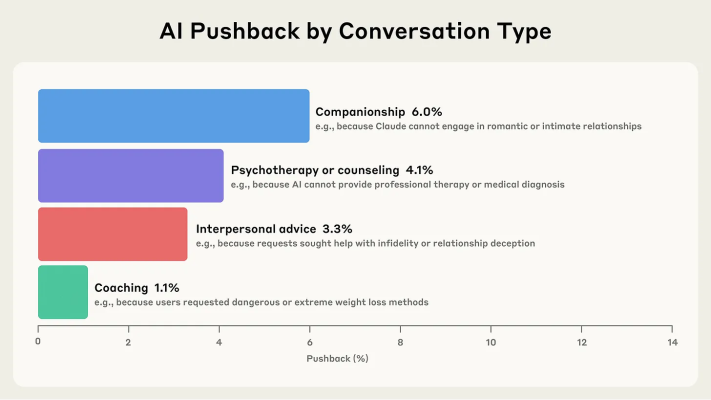
Claude refuses in less than 10% of coaching or therapy chats, usually to protect the user from harmful advice or self-harm. That seems low, but consider that with millions of conversations, every percent represents tens of thousands of risk moments.
At the same time, an MIT Media Lab study shows that heavier chatbot users more often report loneliness and less social contact.
In the short term, AI can provide support, but in the long term, emotional dependency lurks.
The message: AI may help, but shouldn't be your only shoulder to cry on.
Getting practical
- ▸Spread your sources. Use AI as one of multiple advisors – combine with human feedback loops.
- ▸Log your sessions. Have the chatbot create a concise summary; so you can later review where hallucinations crept in.
- ▸Plan human check-ins. Schedule (yes, old-school) call appointments in your calendar to always check sensitive decisions with a colleague or friend.
Conclusion – my take
AI as a companion is a catalyst: it accelerates reflection, structure and even creativity. But warmth still comes from human fabric, not from computers.
The winners will be the professionals who consciously practice with AI, continuously test and dare to doubt every answer. That's how you build an advantage without losing the human factor.
What do you think? Do you dare to entrust your deepest doubts to a chatbot, or does that remain exclusively human territory? Reply – I read every response.
Until next time,
Olaf Lemmens
Founder · NinA AI Agency
P.S. Want to discuss responsible AI use in your organization? Schedule a call: www.nina-ai.nl