Blog · AI Adoption
The 3 problems with AI at work (and number 3 will surprise you)
Olaf Lemmens, Founder NinA AI Agency · June 11, 2026 · 7 min read

When I look at how AI is used at work, I see 3 problems. And the third will surprise you the most.
But let's start at the beginning. By now almost all of us have access to AI at work. ChatGPT, Copilot, Claude, Gemini: they're impossible to ignore. Yet in almost every organisation I visit, I see the same three problems. In workshops, in implementation projects, at board tables. Again and again.
Let me walk you through them.
Problem 1: At work you get an AI that does less than the one you use at home
At home you pay 20 euros a month and get access to the latest models. Deep reasoning, file analysis, agents that perform tasks for you.
At work you get a walled-off chatbot. An old model behind a corporate wall. Or a Copilot license with half the features disabled. Safe, says IT. Unusable, says the workforce.
And what do people do? Exactly. They grab their phone and use their personal account.
This is called Shadow AI, and it's bigger than most organisations dare to admit.
The numbers behind Shadow AI
- 75% of employees use AI for work-related tasks (Awareways trend report)
- 78% of them do so without permission or oversight from IT
- Organisations have visibility into less than 11% of actual AI use within their own walls
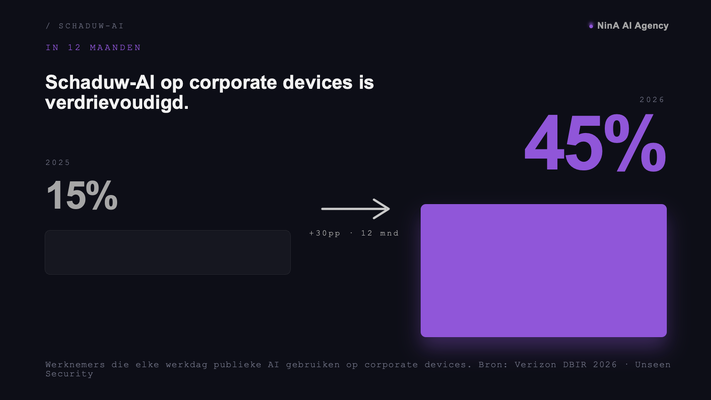
- Shadow AI on corporate devices rose in a year from 15% to 45% (Verizon)
It goes concretely wrong, too. The municipality of Eindhoven reported a data breach at the end of 2025 after employees entered personal data into public AI tools. And this isn't ignorance: nearly nine out of ten employees know new software has to be requested officially. They just don't. The official route is too slow and the official tool too limited.
The lesson: banning employees from using AI doesn't work. You only move the use to places you can't see. Give people a good, safe AI at work, or accept that your company data ends up in personal accounts.
Problem 2: Everyone got a license, nobody got training
The second problem I see in organisations that did solve the first one. They bought licenses. Copilot for everyone, or ChatGPT Enterprise, or Claude. Box ticked, project done.
Except: a license isn't adoption.
In practice I see two extremes:
- People use AI as a glorified search engine. One question, one answer, done.
- Or the other extreme: they let AI do the entire job and forward it unread.
Both miss the point.
The numbers confirm it. Only 36% of organisations have a formal AI policy. Training is often a ten-minute instruction video, if it exists at all. Meanwhile the EU AI Act has required since February 2025 that employees are sufficiently AI-literate. Most companies are nowhere near that.
The real problem isn't in the prompt. It's in the thinking beforehand. Which task do you give to AI? What context does it need? How do you judge if the answer is right? Those are skills, and skills need training. At NinA AI we live by the motto: less prompting, more thinking.
An organisation that does invest in AI literacy gets a double win. Researchers at Awareways see that trained employees demonstrably make safer choices, and that as an employer you become more attractive to talent that wants to work with new technology.
Problem 3: Your colleagues are cleaning up your AI work
And then the problem most people don't see coming. Not because it's small, but because it hides in something that looks like productivity.
Researchers at Stanford and BetterUp gave it a name last year: workslop. AI-generated work that looks polished, but lacks the substance to actually move a task forward. The slick presentation without backing. The twelve-page report that could have been three bullets. The email that triggers an hour of back-and-forth because nobody understands what's actually being asked.
The numbers from their study of more than 1,100 US office workers:
- 40% received workslop from colleagues in the past month
- Each incident takes on average nearly 2 hours to fix
- That adds up to about $186 per employee per month
- For a 10,000-person organisation: over $9 million per year in lost productivity
Here's the paradox: AI makes you faster, but your team slower. You produce a document in five minutes. Your colleague then spends two hours figuring out what you meant, filling in context, and removing mistakes. The work hasn't disappeared. It's been shifted, to someone else.
But the most surprising part isn't the lost time. It's what workslop does to how your colleagues see you.
From the same research, about senders of workslop:
- ~50% of recipients see them as less creative, capable and reliable
- More than a third find them less intelligent
- Nearly 1 in 3 would rather not work with that person again
Read that last line again. Sloppy AI use doesn't just cost you time. It costs you reputation. The trust you build with colleagues over years, you tear down in a few months with forwarded AI output.
So what then?
The three problems are connected, so the solution is too. Three steps:
- Give people serious tools. Not the stripped-down corporate version, but a full-fledged, safe AI environment that can match what people are used to at home. Shadow AI only disappears once the official route is the best route.
- Train the thinking, not just the clicking. AI literacy isn't a button course. It's about task selection, giving context and critically judging output. The AI Act requires it, but more importantly: it's the difference between licenses collecting dust and teams actually getting faster.
- Make one quality agreement. AI delivers your first draft, never your final product. Whoever sends something stays responsible for the content. If you haven't read it yourself, you can't expect your colleague to do so. That one rule prevents more workslop than any policy.
The organisations taking these three steps now are building a lead that will be hard to catch later. The rest will keep buying licenses and wondering why the productivity gains never come.
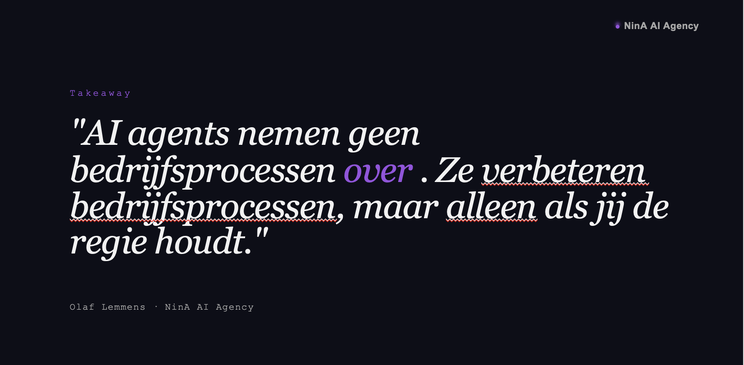
People and AI in harmony. That's what we believe in at NinA AI. People decide, AI accelerates. Not the other way around.
Until next time,
Olaf Lemmens
Founder NinA AI Agency
Sources: Awareways trend report "The rise of the invisible colleague: Shadow AI" (2026), Stanford Social Media Lab & BetterUp Labs "Workslop" research (Harvard Business Review, 2025), IBM Cost of a Data Breach Report (2025).
P.S. Questions about safe AI adoption in your organisation? Plan an intro call. Or visit www.nina-ai.nl