Blog · Startup & Leadership
11 People, 11 Lessons. What I Learned at Every Stage of Our Growth.
Olaf Lemmens, Founder NinA AI Agency · February 20, 2026 · 8 min read
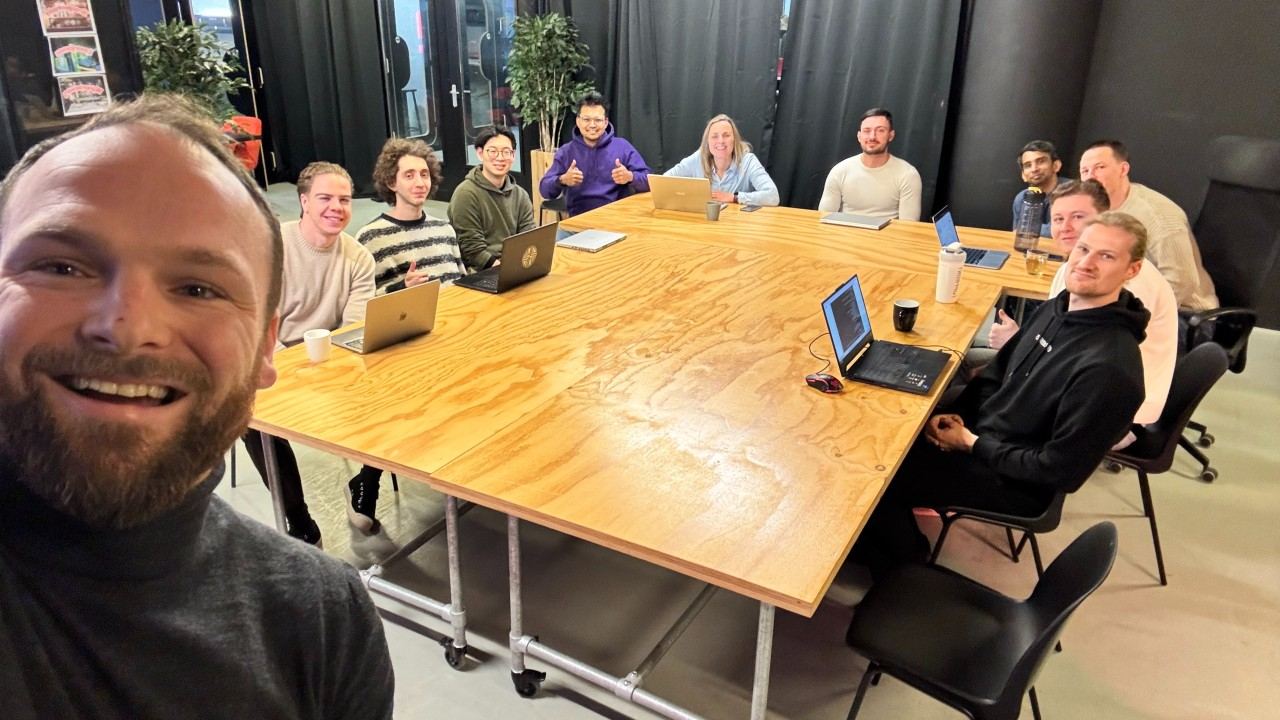
Running an AI company is ironically the most human thing I've ever done.
Last week our 11th employee signed his contract. I was standing in the kitchen of our office in Amsterdam and realized something crazy: two years ago I was sitting alone behind a desk. Now there are 11 people who get up every day to chase the same goal.
That sounds like a success story.
But the truth is more complicated.
Because what I didn't understand beforehand about growing as a startup founder, is that every new employee doesn't just add capacity. Every new employee also adds doubt, responsibility, and sleepless nights.
This isn't humble bragging. This is the honest story of what I learned. Per phase, per person, per blunder.
TL;DR:
- •From solo founder to 11 people: the lessons no management book teaches you
- •Why the hardest scaling question isn't technical, but human
- •How we grew bootstrapped while AI startups worldwide raised $15 billion+ — and why that was a deliberate choice
I – Alone (1 person): You're not as good as you think
"The only real test of intelligence is if you get what you want out of life." — Naval Ravikant
In the beginning I did everything myself. Sales, development, marketing, accounting, making coffee.
And I thought I was doing well.
That was the first illusion.
As a solo founder you have no mirror. Nobody who says: "Olaf, that proposal is sloppy." Nobody who says: "That client doesn't fit us." You confirm yourself all day and call it 'entrepreneurship'.
The lesson: you need people, not because you can't do it alone, but because alone you can't see what you're missing.
II – The first employee (2-3 people): Hire for what you suck at
My first hire was a developer. Someone who had something that was furthest from me. A development background. Hard-core code.
Then came structure.
Because I'm chaotic. Creative, yes. Energetic, definitely. But structure? I score a 3 out of 10 on that (okay maybe a 2).
Most founders make the same mistake: they hire someone who's like them. That feels nice. But it solves nothing.
McKinsey's research on successful scale-ups confirms this: complementary teams perform 2.3x better than homogeneous teams. Not a little better. More than double.
The lesson: your first hire should be your opposite. Not your clone.
III – The development team (4-6 people): Build what clients need
With three developers, two of whom had a Master's in AI, we could suddenly build things I never could have alone. People with a real artificial intelligence background.
And then came the temptation.
We wanted to build the coolest AI agents. The most advanced automations. The technology that would make us stand out at conferences.
But our clients wanted something different. They wanted their safety documentation checked faster. They wanted their customer service available 24/7 without extra staff. They wanted 32 hours per week back.
Not spectacular. Not sexy. But: incredibly valuable.
Harvard Business School put it aptly: "AI is no longer the experiment on the side; it's rewiring how work gets done." And that 'rewiring' doesn't happen with moonshot projects. It happens with processes you encounter every day.
The lesson: the best AI solution is the one your client can test within 4 weeks. Not the one that puts you on stage.
IV – Growing pains (7-8 people): Culture eats strategy for breakfast
Peter Drucker said it. I didn't believe it. Until employees 7 and 8.
Suddenly there were conversations I no longer heard. Decisions made without me. Client contact I no longer handled myself.
And some of those decisions were... not good.
Not because the people were bad. But because we had never established how we make decisions. What our standards are. What we do and don't accept. I had to learn that a startup without explicitly stated culture simply gets the culture that happens by accident. And accident is not a strategy.
The lesson: write down what you stand for. Not because it looks nice on the wall. But because your team needs it when you're not there.
V – The scaling question (9-10 people): Systems versus talent
This is where most startups get stuck. KPMG's latest AI Pulse Survey shows that 67% of companies maintain their AI investments, even during a recession. But only 24% succeed in scaling from pilot to production.
We ran into the same thing. We had talent. We had clients. But we had no systems.
Every client was treated differently. Every AI agent was built differently. Every project had its own structure, or rather: lack thereof.
The breakthrough came when we decided to build modularly. One architecture. One methodology. One way of testing.
Sounds boring. It is. But it's the reason we can still present all our clients with a working POC within 4 to 16 weeks. Not after 6 months. Not after a year. Often after just 4 weeks.
The lesson: systems are not the opposite of creativity. They are the prerequisite.
VI – The eleventh (11 people): Your greatest fear isn't failure — it's success
And now, truly personal.
When I hired employee 11, I got the feeling "Olaf, do you even know what you're doing?" Honest answer: not entirely.
Because growing beyond 10 people as an AI startup in the Netherlands (without VC money, without a large fund) is a choice that has to work out every single month.
Paul Graham, founder of Y Combinator, talks about 'default alive' versus 'default dead'. The question is simple: at your current growth rate and current costs, will you become profitable before you run out of money?
We are default alive. Barely.
But what concerned me more than the numbers was a different feeling.
Fear of succeeding.
Because if this works, if we really become the AI partner of the Netherlands, then I can't go back to 'small and safe'. Then the team keeps growing, projects get bigger. Then we might lose part of our experimental culture. Then it's real.
The lesson: growth doesn't confront you with your weaknesses. Growth confronts you with who you're willing to become.
VII – The 11 lessons in a row
Let me put them together. One lesson per phase.
- 1You need people to see what you're missing
- 2Find your opposite, not your clone
- 3Build what clients need, not what you think is cool
- 4Write down your culture before it becomes accidental
- 5Systems are the prerequisite for creativity
- 6Modular building is more boring and 10x more effective
- 7The first POC in 4 weeks, always
- 8Growing on your own strength forces better decisions
- 9Saying no is a founder's most important skill
- 10Data security isn't a feature, it's the most important thing
- 11Growth confronts you with who you're willing to become
They're not revolutionary. They're not sexy. But they're true. And they're mine.
What I learned about AI implementation from this
The funny thing is: everything I learned about scaling a team also applies to scaling AI in an organization.
Companies implementing AI make the same mistakes I made as a founder.
They start without a mirror (no clear metrics). They hire clones (only technical talent, no change management). They build what's cool instead of what's needed. They have no culture around AI (no governance, no agreements). They lack systems (every department does it differently).
MIT Sloan writes that AI agents in 2026 will enter the 'trough of disillusionment'. That doesn't surprise me at all. Not because the technology doesn't work. But because organizations haven't yet learned how to scale with it.
And scaling is always — always — a human problem.
The future
I still wake up every morning with the same feeling as two years ago.
That we've only just begun.
That the best is yet to come.
And that running an AI company is ironically the most human thing I've ever done.